Wednesday, May 24, 2006

Coffee mugs

Speaking of coffee mugs, I hope someone could modify the common metallic or plastic body coffee mug with a ceramic/porcelain liner inside. I'd be in coffee nirvana and can get by discussing anything with anybody. And don't talk to me about paper, glass, or styrofoam cups please :)...


**************************************************************
"In God We Trust, all others bring data" - W. Edwards Deming

Tuesday, May 23, 2006

Abaya's Next: Antartica article and Dale Abenojar's dubious claim

On the claim of Dale Abenojar that he summitted Mt. Everest and is therefore the first Filipino to reach Mt. Everest, the onus should be on him to prove that he reached the summit. It is NOT for any of us to disprove it. That's how any statement from the mountaineering community should be "framed". Since he made the claim, then he should show the pictures he or his guide took. he should get the "statement" from the Everest lady-historian who documents the climbs. He should get the certification from the Nepalese climbing association. He should also present proof that he got that free meal from the restaurant that awards those who made it to the top. Lastly, he should show his feet and whether he indeed lost a toe or not.

Dale, grow up and quit trying to steal the glory of Leo, Erwin, and Romy. Attached below is a nice article from A. Abaya on the significance of the achievements of Leo, Erwin, and Romy. Read on.


Next: Antartica
By Antonio C. Abaya
Written May 21, 2006
For the Standard Today,
May 23, 2006
We salute our intrepid mountain climbers Leo Oracion, Erwin Emata and Romi Garduce, and their support teams for their success in being the first Filipinos to climb Mount Everest. They have done their country proud.
And congratulations should also go to the corporate sponsors who made their success possible. In particular, taipan Lucio Tan and his corporations, as well as to the rival TV networks ABS-CBN and GMA-7, who sponsored competing teams of mountain-climbers. They apparently received no financial support at all from the government.
Mr. Tan is said to have exhorted the climbers, when they paid him a pre-climb visit, to do it as matter of national pride. "do it for the country. I'd like to see the national flag waving at the summit of Mount Everest. Make the Philippines proud."
Someone here, at least, understands the value of symbolical acts, such as the conquest of Mount Everest, in instilling national pride. Sad that neither President Arroyo nor any of her predecessors does and did, since this is really one of the functions of national leaders: to make the people proud of themselves, their country and their nation.
Several years ago, Malaysian Prime Minister Mahathir Mohamad sent national teams funded by the Malaysian government, not only to climb Mount Everest, but also to trek to the South Pole in Antartica, and to the North Pole in the Arctic. The idea was to instill the "can-do" spirit among Malaysians.
And that is not all, as I wrote in my article Emulating Mahathir (Oct. 06 2004). Mahathir also masterminded the building of the Petronas Towers, to become the tallest building in the world at that time. By contrast, when President Ramos proposed in 1995 the building of what was billed as the Centennial Tower in Luneta for the Philippine Centenary in 1998, conceived to be a contender for the "tallest building" title, it was hooted down by the wise men and women in the press. We are doomed by our own media to being a " can't do anything" country forever.
And it was Mahathir's idea that Malaysia build a national car, the Proton, and a national motorcycle, admittedly with foreign minority partners. Not just by assembling parts manufactured in other countries, but by progressively fabricating more and more of those parts domestically, eventually including their engines. They have since produced more than two million Protons, tens of thousands of which have been exported. That is real industrialization, not mere assembly of imported components.
By contrast, the Philippine automotive industry, which started at least 25 years ahead of the Malaysian, never graduated beyond assembling imported components, except for some innocuous parts like wire harnesses and seat upholstery (in which, at any rate, the raw wire and fabric material are still imported).
And it saddens me that the world-class victories of Manny Pacquiao in boxing and Bata Reyes and Django Bustamante in billiards have not been utilized by the national leaders to launch talent-search competitions in those two sports among our young people, to develop new pools of talent and, incidentally, instill national pride and give them positive outlets for their youthful energy.
That boxing and billiards are two sports that are popular among the masa should have been added incentive for government to promote these sports among them, to instill in them not only national pride, but also the spirit of self-discipline and a striving for excellence among an underclass seduced by drugs, gang violence and mindless TV fare such as Wowoweee and Eat Bulaga..
Not just in sports. Anyone who watches DVDs of the world's best symphony orchestras: Berlin, Vienna, London, Amsterdam, New York, Boston, Philadelphia, Montreal- would notice that there are always several Asians among the orchestra members. But they are invariably Chinese, Japanese and/or Korean. No Filipinos, even though, culturally, we have a closer affinity for Western musical idioms than do northeastern Asians.
What this means is that young Filipino (serious) musical artists are not being given the opportunity to hone their skills abroad. Even the superb Gustav Mahler Jugend Orchester (Youth Orchestra) under Claudio Abbado, which has members from more than 20 countries, including Cuba and Venezuela, does not have a single Filipino.
Whatever one may say about Imelda Marcos and her pretentiousness and vulgar extravagance, she at least was personally responsible for the training to world-class caliber of Cecile Licad in the US and Rowena Arrieta in the Soviet Union. By contrast, in spite of their more pedigreed upbringing, neither President Aquino nor President Arroyo - forget the culturally ignorant Estrada and Ramos - did or has done anything to promote music and the arts.
And not just in sports and music, and their potentials for nation-building, are our national leaders clueless and uninterested; they are more so in science and technology.
Sometime in December 1989, I suggested in private to a highly placed individual that the Aquino government negotiate with the US and Soviet governments for the inclusion of qualified Filipino military officers in their astronaut-cosmonaut training programs.
I never heard any feedback to that suggestion, but since 1989 astronauts-cosmonauts from Japan, China, Korea, India, Indonesia, Brazil, Israel, etc have flown into space orbit
Imagine what a boost to national pride it would have been if the Philippines had been the first Third World country to have an astronaut-cosmonaut orbiting in space. In addition, such a symbolical act would have endeared the military to the government and discouraged coup-plotting by malcontents.
It would or could have been used to boost young people's interest in science and technology, as it certainly did in the US in the late 1950s, when the US strove to overcome the lead of the Soviet sputniks.
Most of all, it would have given media and the entire population some new authentic heroes to look up to, instead of the usual tiresome glib-talking politicians and brainless showbiz fornicators that Philippine media love to shower their attention.on.
On to Antartica!. *****

Thursday, May 18, 2006

Mt. Everest and the Philippines

Historian Ambeth Ocampo wrote today on one interesting trivia about Mt. Everest and the Philippines in the Inquirer. The daughter of Tenzing Norgay, Nima, married a Filipino, the late renowned graphic designer Emmanuel "Noli" Galang.

The other interesting observation is the difference in how Hillary and Norgay celebrated their summit. Hillary was victorious and planted his country's flag. When Norgay died in 1986, he announced that he was the first to reach the Everest and even claimed that Norgay was a weak climber during his sixth or seventh attempt to summit Everest.

Norgay in his memoirs offered a ceremonial sacrifice to Chomalungma including an ordinary pen from his daughter Nima. Being a devout Buddhist, he wanted to pay his respects to the mountain and his surroundings. He was humble and acknowledged that summiting Everest was and still remains a team effort.

Someone raised the fact that all the foreigners that summit Everest are celebrated, but the Sherpas remained anonymous. I know this isn't entirely true, since Boy recently put out a link of the famous Sherpa climber Babu Chiri Sherpa and there are many articles on the Sherpas. Still, I hope the Pinoy climbers provide us with the names of their guides so we can honor them as well.

Afterall, Nima Norgay-Galang is also a Filipina.

Check out the links:


**************************************************************
"In God We Trust, all others bring data" - W. Edwards Deming

Wednesday, May 17, 2006

congrats to all mountaineers

Mabuhay kay Leo Oracion and to the FPMEE team for scaling up Mt. Everest.

All the best to Romy and E. Emata on their forthcoming assualts.

Salamat to the original alpine climbers Bubut, Nokman, Joel Sol-Cruz, and Albert for getting this started. Salamat rin to the first Kota Kinabalu climbers.

Salamat sa UPM founders for organizing UPM and getting all of us into mountaineering and environmentalism.

Mabuhay kayong lahat.

Hecky


**************************************************************
"In God We Trust, all others bring data" - W. Edwards Deming


Leo Oracion reaches Mt. Everest summit May 17,2006 5:30 PHT

Mabuhay ang Pilipinas! Congratulations to Leo Oracion for summiting Mt. Everest. U.P. Mountaineer Romy "Garduch" Garduce should be attempting a summit assault by tomorrow. Next year, the First Philippine Mt. Everest Expedition (FPMEE) will attempt to summit Everest as a TEAM.

I look forward to more Pinoys climbing Chomalungma, the seven summits (mountains over 8,000 meters), and exploring more of the world.

Now if only we can fix our economy and politics...

Mabuhay to all the outdoors people and environmentalists!

Hecky


"1st Philippine Mt. Everest Expedition Website" <info@philippine-everest.com> wrote:
From: "1st Philippine Mt. Everest Expedition Website" <info@philippine-everest.com>
Subject: Leo Oracion reaches Mt. Everest summit May 17,2006 5:30 PHT
Date: Wed, 17 May 2006 18:57:58 +0800 (CST)
To: undisclosed-recipients: ;

"The Philippine eagle has landed at the summit of Mt. Everest," says Oracion upon reaching the summit.

Visit http://www.philippine-everest.com for more updates.

Regards,
info@philippine-everest.com


**************************************************************
"In God We Trust, all others bring data" - W. Edwards Deming

Friday, May 05, 2006

Tucson Weekly- Tom Danehy's distortion of Cesar Chavez's work

It seems Danehy fell for the distortion of Cesar Chavez’s position on undocumented immigrants currently permeating the Web and online discussion groups. The UFW and other relevant university websites with UFW/Chavez material indeed show that Chavez and the UFW opposed the Bracero POLICY. They protested against companies hiring undocumented immigrants. Unlike present day hatemongers, they DID NOT demonize undocumented immigrants or sought to make them felons. They saw undocumented immigrants as victims and not as the primary cause of low farm wages and unsafe working conditions. As Rev. Jesse Jackson noted, braceros did not come over, they were brought over by the collusion of the U.S.-Mexican governments and by greedy U.S. companies. To UFW/Chavez, the blame rested entirely with American companies supported by unethical politicians. Some braceros, inspired by Chavez/UFW, joined the UFW, while UFW extended assistance to bracerors. UFW also negotiated with the American agri industry on the historic AgJobs and 1986 immigration bill that eventually led to the legalization of 1.3 million undocumented farmworkers. In the current immigration debate, UFW is calling for a comprehensive bill that provides a path to legalization for undocumented immigrants. Chavez worked on the MOVEMENT, which sought to address issues on worker rights, civil rights, health, safety, and environment, social security and social integration of workers, etc. He saw the situation of the poor, excluded, and the weak and sought a holistic and comprehensive solution. The immigration movement at present is pushing for a comprehensive immigration reform. Danehy picks up on Chavez’s position on the bracero program, but removes it from its historical political economy context. By asking how many immigrants should be let in, his question distorts the complex issue of immigration and frames in the controversy by focusing solely on undocumented immigrants. If Danehy wants to talk about numbers, he should start with the numbers related to the impacts of neoliberal economic policies and crony capitalism on workers and communities. It seems that shame should be on Danehy.

Thursday, April 27, 2006

Why the oil price hikes?

I got this link from OpEd news of Rob Kall. It provides a 4-page deconstruction by a Joel Peskoff of the reasons given for the recent oil price hikes.

http://www.billcamarda.com/Phony%20Rationale%20for%20high%20Oil%20Price.pdf

The usual reasons: Iran risk factor, decreased oil production from Iraq, China as a competitive oil consumer, increased global demand, etc. are not in congruence with the data. Petroleum consumption is just up over 1% from last year and oil stocks are at high levels, i.e. there is no shortage. Speculation though by oil futures traders is rampant. Interesting article, since it links the oil industry to financial capitalism.


**************************************************************
"In God We Trust, all others bring data" - W. Edwards Deming


Yahoo! Messenger with Voice. Make PC-to-Phone Calls to the US (and 30+ countries) for 2¢/min or less.

Monday, April 10, 2006

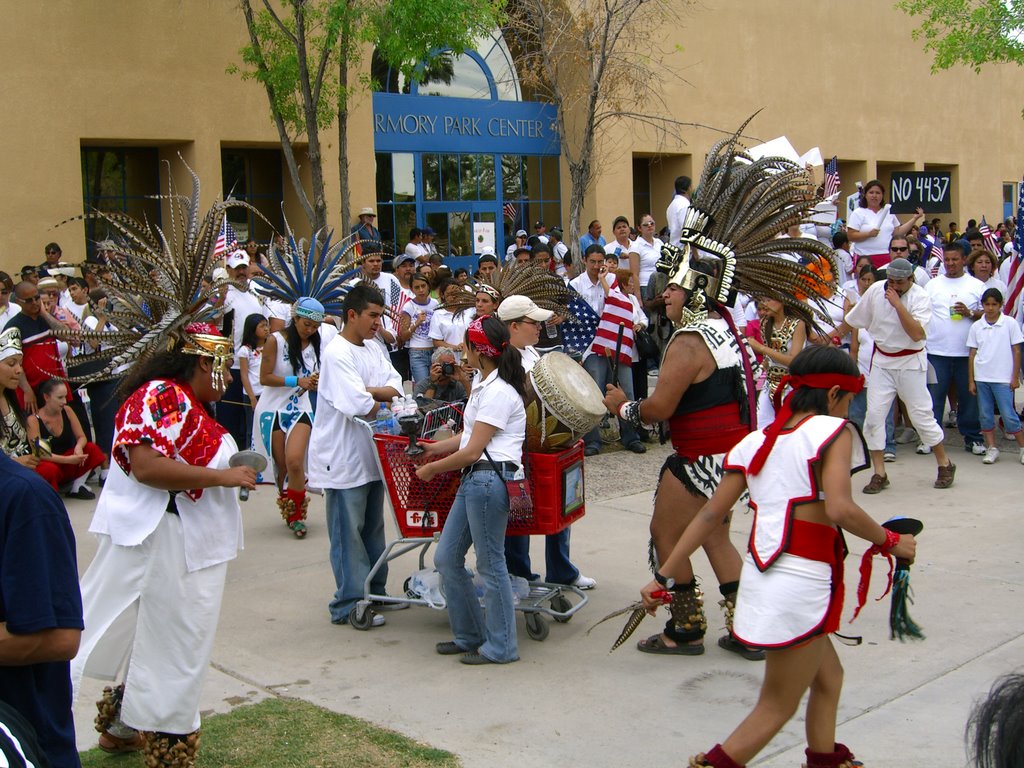
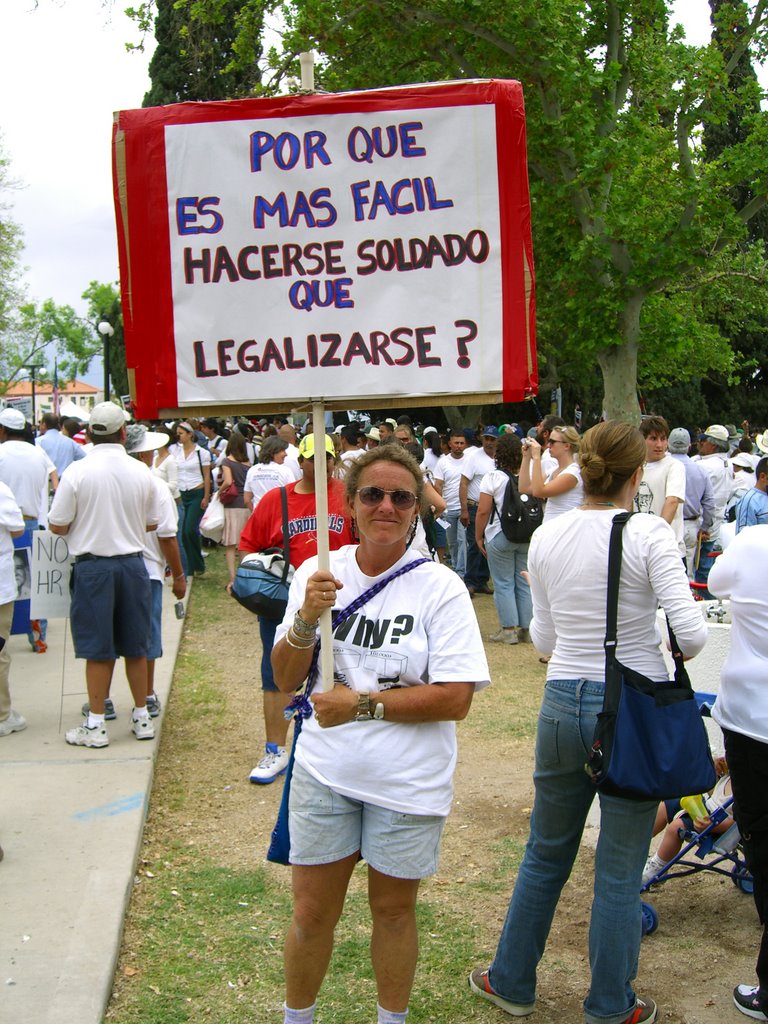
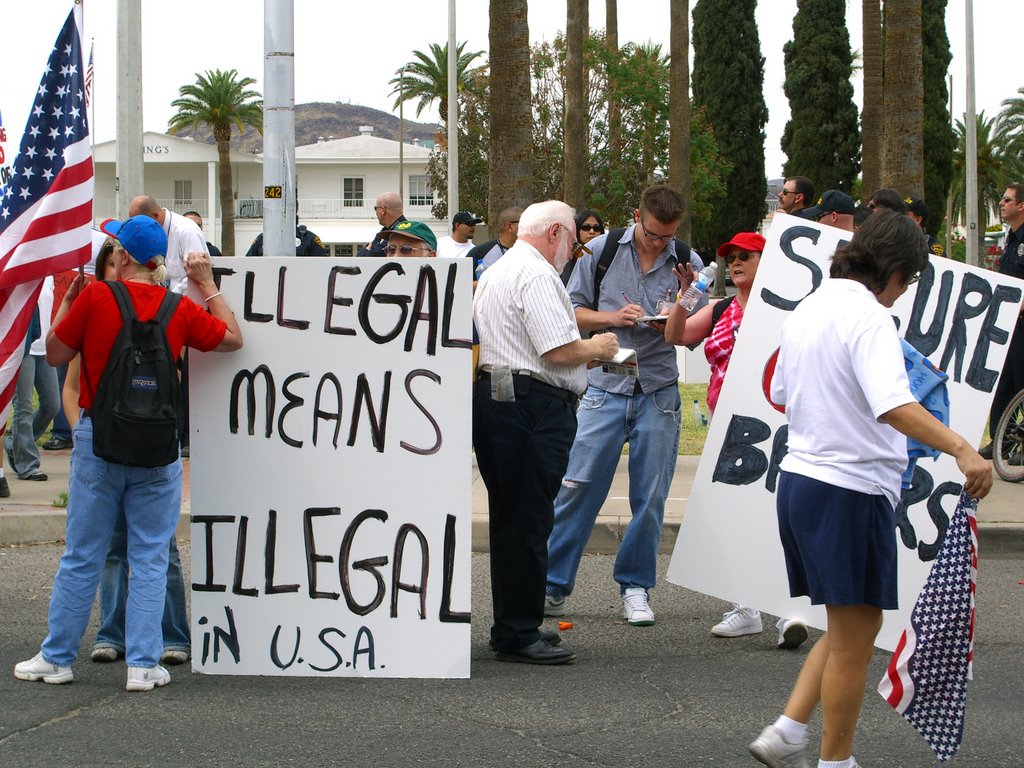
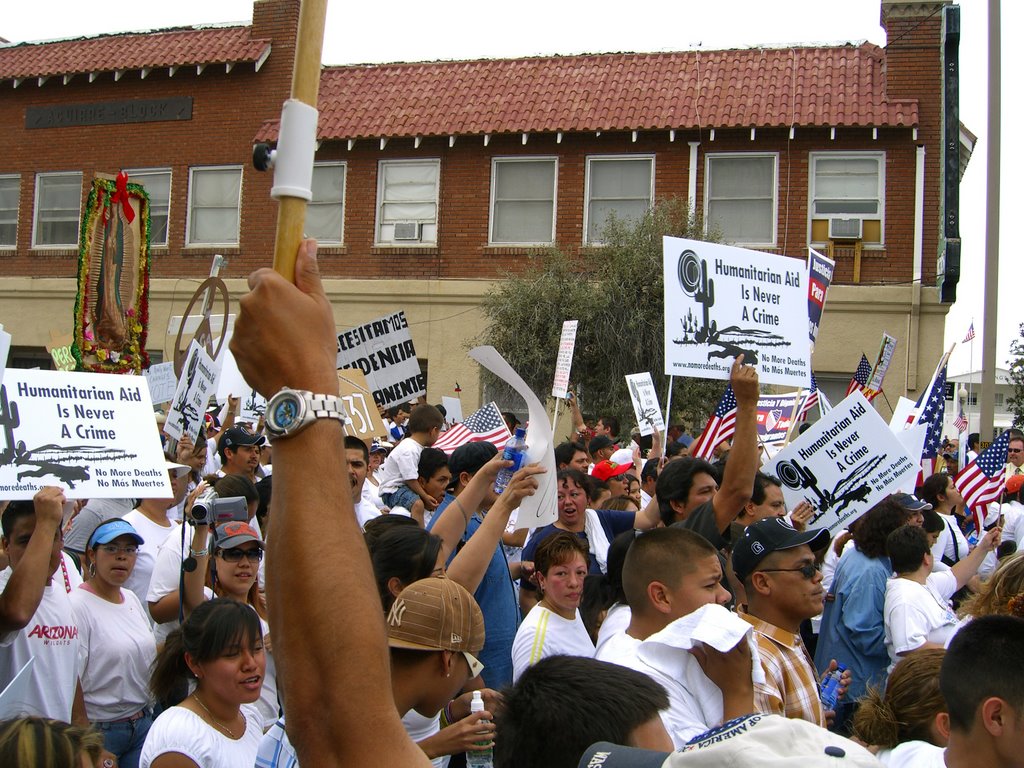
The Art of Protest. Tucson immigration march, April 10, 2006


long-haired anti-immigrant to bald migrant protester:
"just grow your hair a little pleeeease"


Dance of protest


Can someone please give me an answer

Pictures of hate. Tucson immigration march, April 10, 2006

Hate-mongers or just anti-immigrant?


Why so few? Apparently hating is not widespread in humans.


What is illegal when many are impoverished and so few own so much?


Profile of anti-immigrants. Let's pray for them.

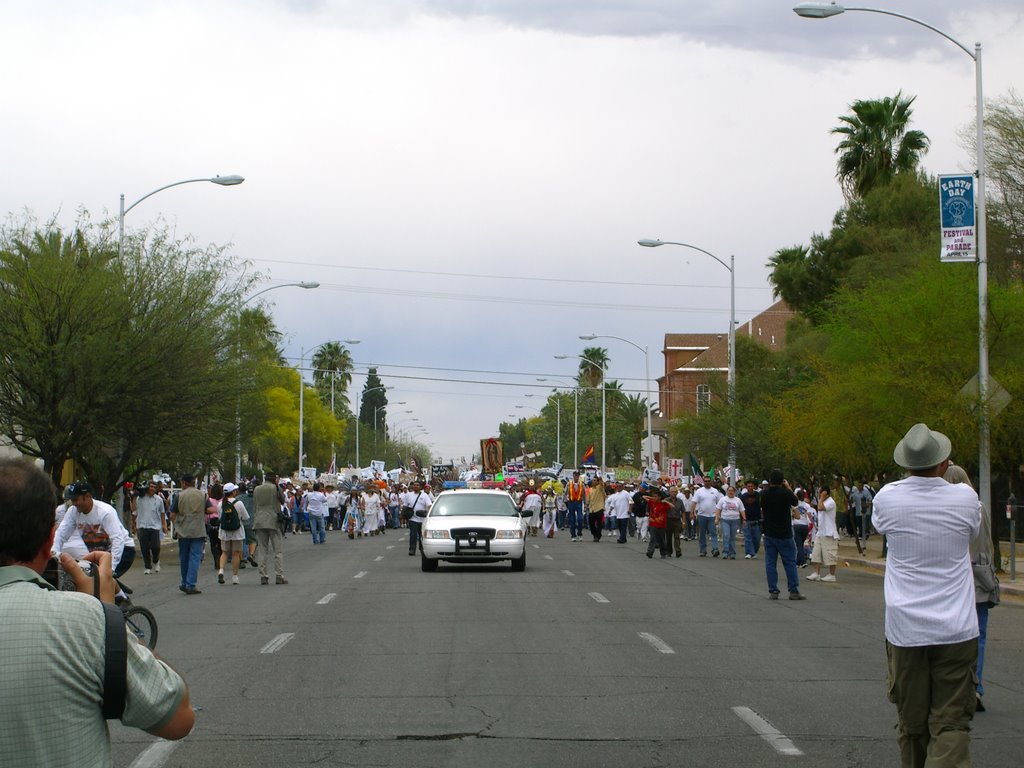
Tucson immigration march, April 10, 2006


Marchers coming in from Ajo and 12th St.


Festive atmosphere at Armory Park

Humanitarian aid is never a crime


Thousands of marchers.

Saturday, March 25, 2006

Green Map Metro Manila, Philippines now on-line

Dear friends and colleagues,

Please check out the BETA version of Green Map Philippines at:

http://www.one-environment.ph/portal2/greenmap/greenabout.htm

Finally, after many attempts at putting everything together using our lunch money (baon), we decided to put out this version, which provides an overview of the urban environment of Metro Manila and an on-line map of the "green areas" in Metro Manila. The map contains only a small number of the over 500 sites we consider "green" and culturally and educationally significant. In the coming months we will be establishing our own URL (www.philippinegreenmap.org) putting in an online-registry for comment and verification of the identified green sites, updating the map, starting the planning for a hard copy version, adding pictures of green sites, etc. Green Map Manila is part of the environmental portal set up by various organizations and hosted by the Development Bank of the Philippines at:

http://www.one-environment.ph/

Check out the flash intro-really cool.

We'll appreciate your comments and if you have any IT, mapping, GIS, or graphic design skills, please volunteer and help in making this a better Metro Manila Green Map.


Maraming salamat kay Wendy Brawer and Bob Zuber of Green Map NY (that's many thanks Wendy/Bob), Yvette Fernandez for giving me her NY Green Map in 2001, and the GMS team of Jobo, Alex, Michelle, Nokman, Rex, Bunny, Ninoy, Leo, Tams...

Mabuhay!


Hecky Villanueva


**************************************************************
"In God We Trust, all others bring data" - W. Edwards Deming

Thursday, March 16, 2006

WANT HYPERWAGES? DEMAND A UNIVERSAL BASIC INCOME

What’s wrong with a free lunch?

Nothing’s wrong according to Belgian economics professor Philippe Van Parijs in his 2001 book with the same title. Van Parijs or VP is one of the leading proponents of the Universal Basic Income (UBI) or Basic Income Guarantee (BIG). Never heard of it? Don’t be ashamed; I haven’t till recently. The UBI is an income a government pays, at a uniform amount and in regular intervals, to each adult permanent resident, regardless of his/her economic status and whether s/he is willing to work or not (Van Parijs 2001:5). It is guaranteed because the government is required to pay each permanent resident this amount. It is basic because the amount is “something on which a person can safely count, a material foundation on which a life can firmly rest” (Van Parijs 2001:5-6). As defined, it can either fall short or exceed the amount needed to fulfill the “basic needs”. Why is a UBI desirable? VP lists the following main points below.

It is just. Social justice is equivalent to real freedom for all. Freedom is normally equated with enforceable property rights and personal liberties. What should be added to this is the means or resources to use these personal liberties. VP calls this the distribution of opportunity, which should be designed in such a way that those with the least opportunities be given real opportunities. Providing a UBI is one way.

It promotes real jobs and sustainable economic growth. VP notes that Europe and America’s economic difficulties are different in that in the former there is limited poverty and high unemployment, while in the latter, it has low unemployment and widespread poverty. Technology advances have been eliminating jobs. It would take massive economic growth to stabilize employment levels. However, this would severely impact the environment and labor benefits. What to do? The UBI, according to VP, subsidizes the employee. It allows the employee to accept a job at lower pay or not to work at all. It also allows him/her to bargain harder with the employer, take a break, re-train, become an entrepreneur or self-employed, or do social work. On the employer’s side they have the option to offer a lower wage for non-critical positions and to offer more to their important employees. It is a win-win solution.

It is gender sensitive. Women have taken a disproportionate amount of the household “caring” functions. They have also been discriminated in the workplace in terms of pay and career advancement. A UBI gives them more financial independence to take care of the household and family, or from an abusive husband and more bargaining power from a discriminatory company.

It is environment-friendly. Environmentalists, according to VP, face an obstinate foe in “productivism, the obsessive pursuit of economic growth” (Van Parijs 2001:20-21), which generates pollution, consumerism, and uses up scarce natural resources. Accelerated economic growth is justified on the grounds of reducing unemployment. VP notes that working class organizations have bought into this argument. The UBI addresses unemployment without promoting “productivism” and undermines this broad argument. It forces business and industry to rethink their business programs. For environmentalists, the UBI provides them with the volunteer manpower who can now afford to work on environmental programs.

What are the objections?

It costs too much. Not really if a wide range of existing welfare benefits are abolished, tax collection becomes more efficient, tax exemptions minimized, economic rents are collected (from natural resource exploitation and use of government land), and the government cuts back on pork barrel expenses. Note that the UBI does not necessarily need to meet the individual’s “basic needs”. That is the goal, but it isn’t required.

It distorts labor supply. This is a non-issue according to VP. The goal should be sustainable economic growth not an “overworked, hyperactive society” (Van Parijs 2001:23). A productive adult does not necessarily have to be earning a living. They could be taking care of their children, elderly relatives, or volunteering. All these improve human capital and reduce costs on peace and order, prisons (better socialized youth), hospitalization (healthier families and elderly relatives), and other social service expenses that could be handled by less-stressed families.

It is unethical and immoral to get something without working for it. This is the reciprocity issue and is the basis for Clinton’s workfare welfare reform. VP likens this to the Malibu surfer who would spend his/her time on the beach and not work. Again, the response would be so what? The other response is that the reciprocity issue takes a dim view of human nature and discounts the human drive to be a productive and useful member of society. Really, how long and how often can you surf in Malibu without getting bored, injured, or even sun-burned? The third is, the UBI is not really enough for one to live a life of luxury. It is only a basic income.

Lewis et.al (2005:2) also noted that “tough love” policies, e.g. workfare, while supposedly providing more incentive to work, have, in the neo-liberal era, encouraged employers to pay less than living wages. Further, they advise value-neutral economists to note that many Americans have made the value judgment that workers should earn living wages and employers not paying living wages are morally reprehensible. Hence, value-neutral economists should take this value judgment into account in their assessments and policy recommendations, e.g. how to achieve living wages. This view has been supported by recent philosophical literature, while psychological research and evolutionary game theory lend support to altruistic motives and action, as well as cooperative behavior, and refutes the fear that individuals will free ride (not work) with a UBI (Lewis et.al 2005:2-3).

Lastly, the reciprocity issue is fallacious because everyone who became successful did so because of a combination of one or the other of the following: family line, ties, and resources, government support (tax breaks, public education, incentives, etc.), help from friends or relatives, pure luck, utilization of natural resources or public land/resources. No one really is self-made. Hence, the UBI ensures that everyone gets a fair chance.

The idea and concept of the UBI is not new or radical. In the United States it has been proposed in one form or another as early as 1796 when Thomas Paine proposed his version in Agrarian Justice (Lewis et.al 2005). Personalities from the left and right have supported a UBI like John Kenneth Galbraith, Milton Friedman, Richard Nixon (the watered down “Family Assistance Plan”), George McGovern (the “demogrant” proposal), Martin Luther King, Huey Long, and Bertrand Russell, among others. James Tobin wrote the first academic article in 1967. Nobel winner Frederick Hayek mentioned it in 1944. They all saw it as a scientific and simplified solution to poverty, a logical alternative to the welfare state, and a key tool for promoting human liberty.

In 1982, Alaska and the United States for that matter, was the first to institute a UBI in the form the Alaska Permanent Fund (APF). Throughout the years, the APF has provided each resident of Alaska annual dividends ranging from a low of $331 in 1984 to a high of $1964 in 2000. By an amendment of the constitution of Alaska, “At least 25 percent of all mineral lease rentals, royalties, royalty sales proceeds, federal mineral revenue-sharing payments and bonuses received by the state be placed in a permanent fund, the principal of which may only be used for income-producing investments." Thus, the APF market value currently stands at around $34Billion invested in stocks, bonds, real estate, and CDs. Alaska residents favor the APF dividend and it has worked to reduce poverty in the state. See http://www.apfc.org/index.cfm.

Brazil passed the “Citizens Basic Income” legislation in 2004 paving the way for gradual implementation of the UBI (IPA 2005). Senator Eduardo Matarrazo Suplicy, a key ally of Brazilian president Luis Inacio Lula da Silva, has pushed for a UBI since 1991 when he authored legislation for the negative income tax wherein each citizen would receive an income supplement of between 30-50% of the difference between his/her wage and $150. Brazil also experimented with the UBI in the education and health sectors, Bolsa-Escola and Bolsa-Alimentacao programs respectively (Suplicy 2001:249). With the new legislation, Suplicy estimates that 11.4 million families or 46 million citizens, representing one-fourth of Brazil’s population of 182 million will be enrolled in the UBI program in 2006.

Portugal has a 1997 law ensuring UBI or BIG. It is being implemented for the poorest of the poor with a “social contract provision”, e.g. work eventually to become finanically independent. Initial reports show conditional success; since the implementation is only partial (da Costa 2002).

The UBI is feasible in the G8 countries and there are many versions of this. Belgium, UK, and the Netherlands have tax codes that closely reflect BIG. Libertarians, capitalists, and leftists support UBI. Neo-liberals and many leftists do oppose UBI, basically on the reciprocity issue and incentive not to work fear.

What can be more radical than the UBI? Why haven’t the progressives in the Philippines pushed for this? Is it feasible in the Philippines? Why aren’t our politicians exploring UBI? With UBI, the hyperwage theory has another roadmap to implementation. Isn't it time for a Philippine chapter to promote UBI/BIG?

References:

Clark, Charles M.A.

2002 The Basic Income Guarantee: Ensuring Progress and Prosperity in the 21st Century. The Lifey Press, Dublin, Ireland.

Groot, L.F.M.

2004 Basic Income, Unemployment, and Compensatory Justice. Kluwer Academic Publishers, Dordrecht, The Netherlands.

Van Parijs, Philippe

2001 t’s Wrong with a Free Lunch? Beacon Press, Boston.

Widerquist, Karl; Michael Anthony Lewis, and Steven Pressman

2005 The Ethics and Economics of the Basic Income Guarantee. Ashgate Publishing Ltd., England.

Useful links:

Basic Income Earth Network: http://www.etes.ucl.ac.be/BIEN/Index.html

The U.S. Basic Income Guarantee Network: http://www.usbig.net/

Global Income: http://www.globalincome.org/LinksEnglish.html

Livable Income for Everyone: http://www.livableincome.org/links.htm

Ireland BIG: http://www.cori.ie/justice/basic_income/index.htm

Brazil experience: http://www.brazilink.org/politicspapers/Suplicy_Columbia_2005.pdf

Portugal BIG: http://www.etes.ucl.ac.be/bien/Files/Papers/2002BrutodaCosta.pdf

Tuesday, February 28, 2006

The Third View (Plot in Manila)

The Third View

While many of us lament what happened last week during the EDSA 1 anniversary celebrations, the antics of various individuals and parties revealed again their priorities and hidden agendas. In the end, there were no saints last week. All were tainted. The personalities and institutions we expected to provide maturity, wisdom, and guidance on the nation’s political economy have once more shown how short-sighted and impotent they are. On the brighter side of things, this catharsis will be good for us as a nation. The past week only urges us to immediately get on with remaking our political and social institutions if we are to be independent of the clowns in government, the legislature, opposition, civil society, church, and media. As I have been writing recently, we need to focus on creating individual wealth in order to develop our respective communities, because it will be individuals active in the Community that, in the end, will be both the defender and promoter of our liberties. By community, I mean us ordinary citizens, working hard and helping one another to sustain our families, our neighborhood, our town, our province, and nation; what scholars have referred to as real people doing real things.

Let me get a few things clear. I am no fan of GMA. I think she is just our employee, appointed by us, the citizens, to get the Philippine development program started. Because we took a big risk in getting Estrada ousted, GMA is indebted to us. After EDSA DOS, we demanded genuine reform from GMA, as expected of a leadership gained by extraordinary means. That is the social contract GMA entered with us. So far, she has done a poor job vis-à-vis the enormous social capital she had when she became president in 2001. The poor perception on her family members and relatives, her ‘cronies’, the incompetence of her appointees, among others, reflect on her own competence, integrity, and leadership. The economic gains we are currently experiencing are only partly attributable to her administration and are most probably due to OFW remittances and good corporate earnings. I think that she knows she is under severe scrutiny vis-à-vis her performance. We demand performance because we "hired" her, are not scared of her, or are in awe of her.

The fact that the citizenry is not scared or in awe of her is an important distinction. Opposition parties, biased columnists, idealistic rightwing military officers, and the malleable media think that Proclamation 1017 is a harbinger of military repression. There will be military repression, but it will be these personalities that will be directly affected. Not us, because we can take care of ourseleves. They have lost credibility with most Filipinos because of two critical aspects, namely, their hidden agendas and interests, and their Machiavellian attempts at usurping political power. Let me reiterate what is already common knowledge.

Cory Aquino and the Cojuangco clan are under threat of their 6,000 hectare Hacienda Luisita being land reformed. Soldiers protecting the hacienda from striking workers shot and killed several of them last year. Cory and her supporters have teamed up with Estrada supporters and Marcos loyalists to force GMA to resign. Is GMA’s administration so bad that we must strike unholy alliances with the Estrada group that nearly (allegedly) turned the country into a narco-state, or with the Marcoses that (allegedly) led the country into bankruptcy, devastated our environment, and committed countless human rights violations? Is this the price we need to pay to kick out GMA? Have Cory, that group named after a hotel, and the civil society folks reflected on the immorality of this alliance and the distaste that it generates on us who risked much in EDSA 1 and 2?

The other point is that newspaper columnists, once very influential, are steadily losing their credibility and high moral ground. As columnists, they naturally write about their view of a situation. Nevertheless, they need to do a little basic research and fact-checking. They have brought the term “arm-chair” writers to a new level with their biased and hysterical writing. Was there really a coup attempt or not? Who were the plotters? Why has the Tribune still been able to publish despite the clampdown? Do you think it is solely because of the courage of Cacho-Olivarez? Why was there no People Power IV? A friend, a political economist, raised the gender issue in the unceasing attacks on GMA and Cory during her own presidency. Has anyone explored this angle? Many questions have been raised but institutions tasked to provide timely and nuanced information have not done so now or in the recent past.

The fact is the media and newspaper columnists are both generally biased and malleable. To get a clearer picture of an event, one needs to read the reporter’s probably biased account, the pro-administration columnist’s viewpoint, and the oppositiion columnist’s version. By triangulating these three versions, one hopes to get a clearer picture of what is happening. This is too much effort and is unfair to the paying reader. In this aspect, media has failed its most important constituent, the reader. Thus, there is little sympathy when an opposition newspaper is invaded by the police or a columnist is arrested during a rally.

Some anti-GMA columnists write about the indifference of the citizenry to what is happening. I think this is insulting to us citizens. The perceived indifference of the citizenry should be interpreted to mean this: non-participation at last week’s events or even the past year is an indictment of the opposition, the biased media, and the power grabbers. Our issue with the opposition is their unconstitutional power-grab attempts. Our issue with media is their bias and incompetence. Our issue with rightwing military officers and the communists is their long history of human rights violations and perceived lack of management skills. How could you expect the citizenry to rise up? Rise up in defense of them? Defend what, institutions that these parties have coopted to further their hidden agendas?

Our issue with GMA is her governance, which should be dealt with on a daily basis. Filipinos are not stupid. They are watching from the sidelines as these detested personalities fight it out. Filipinos will act to protect their liberties when the time and need arise. EDSA 1 and 2 proved this. They will not, however, be used by parties with hidden agendas. I disagree that the reservoir of People Power has dried up. I think it is transforming. The Gawad Kalinga, RockEd.org, and OFW movements are examples. The burgeoning debate on basic income or even hypwerages is another. A third way is on the way. It is neither right nor left. It is about Community.

Monday, January 16, 2006

Further comments on the Hyperwage Theory

I’ve been trying to catch up with the comments on the StreetStrategist’s Hyperwage Theory (the theory was published Businessworld and at http://streetstrategist.weblogs.us). I just wanted to reiterate that hyperwages are actually being implemented in the Philippines at present. The Left and many of us say that there is a small elite class in the country that need to share their wealth. I would like to think, however, and as someone once wrote, that there are First World communities even in Third World countries. This is clearly seen when an Inquirer columnist recently wrote about some CEO-Taipans who pay themselves from a low of P3 million up to P25 million a year on company profits of from P1 billion to as much as P7 billion. I would also be curious to find out how much their other managers earn and how and where they reinvest and spend their income. As I wrote months ago, Ayala Land managers buy Ayala Land stocks and properties. Do Metrobank officers buy Metrobank investment instruments? In this scenario, hyperwage is a ‘real physical process’ and needs to be expanded.

How to expand and where? Metro Manila and not East Timor is the best place to do this. Afterall, the Hyperwage theorist is from Metro Manila and has developed a cult of believers, most of whom are professionals and entrepreneurs. This could be the starting point to achieve the critical mass needed. Second, Metro Manila is the ideal setting to implement the theory. It has a large population (12million) and is the country’s financial, commercial, industrial, educational, political, economic, and social center. It is highly urbanized and diverse. It’s residents have the intellectual and economic status to implement something this radical, yet simple. It is also strategically located to national, regional, and international markets.

Lastly, the biggest domestic market is Metro Manila. With its population, the Keynes multiplier effect could easily occur, be observed, and measured.

What I take away from the many postings and from what I have been reading elsewhere is this: the world is in flux and many areas of the world are in systemic crisis. Being currently based in the U.S., I see the present Bush Administration overseeing a radical overhauling of the economy based on minimizing welfare (social services spending), lowering corporate and personal income taxes (for the top 3%), and unregulated free trade. Wal-Mart, with 2005 sales of only $314 Billion, has initiated a “race to the bottom” in terms of consumer prices and living wages. The Wal-Mart business model seems to be depressing wages, de-industrializing the U.S. (the emphasis on cost efficiency has forced many U.S. firms to relocate to China) and gutting jobs, and eventually lowering the living standards of middle class America. As a petrochemical industry briefing noted, their top three clients are: (1) China, (2) Wal-Mart, and (3) the rest of the world.

The flipside of this is the rise of what is called base-of-pyramid (BOP) initiatives. Because of dim employment prospects, the poor are being encouraged and assisted to enter into entrepreneurial activities. Tens of thousands (no exaggeration) of community organizations, NGOs, and fair-trade activists have organized commercial firms trading (fairly) everything from shade-grown coffee to solar cookers. These are social movements addressing the ill effects of brutal free trade by defining and operationalizing fair trade, e.g. market economy with a heart.

The other trend I’ve been reading about is the growth of the underground economy and of illegal activities. Eric Schlosser’s second book, Reefer Madness: Sex, Drugs, and Cheap Labor in the American Black Market (Houghton Mifflin 2003) writes that the confluence of a moralistic-legalistic government, technological advances, and the huge profits that can be made in the burgeoning black market, have made illegal activities rival the mainstream economy in terms of size. Neo-classical economics has not accounted for this.

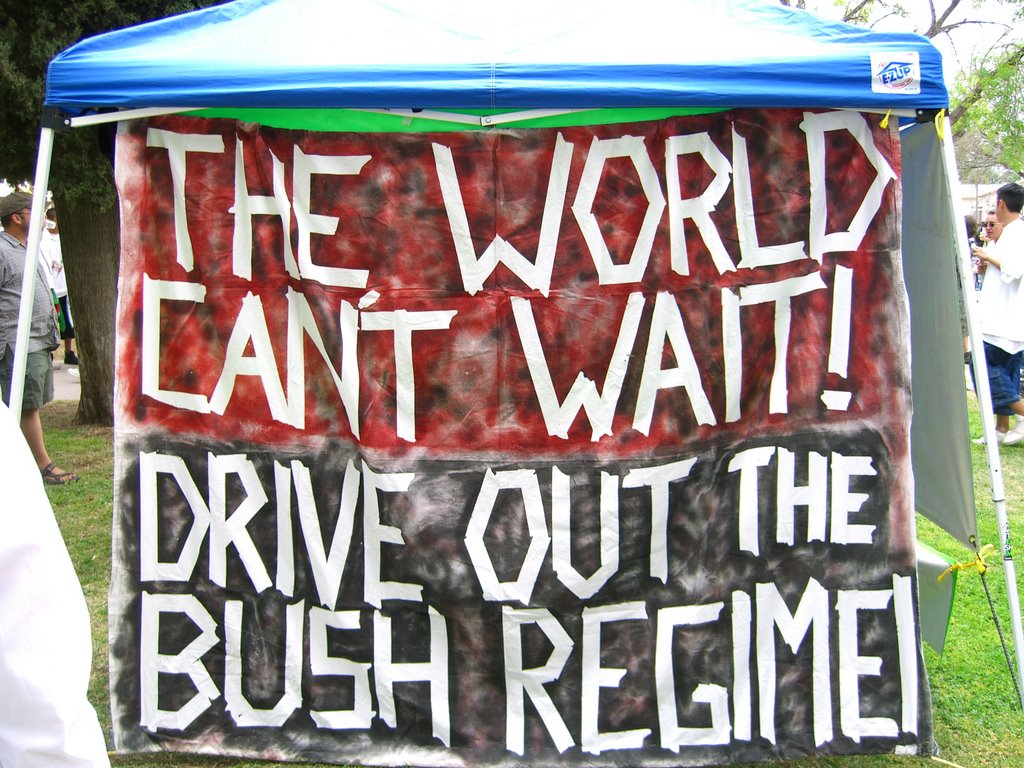
Thus, while one critic correctly writes about the conspiratorial activities of the U.S.-EU-World Bank-IMF-global financial capitalists; individuals, communities, and states still have agency. They can still act, react, mobilize, and strive to counter the effects of economic injustice (the “structure”). Schlosser uses the term “brittle” to describe the unsustainability of the law enforcement framework based on a moralistic and self-serving agenda. When a society is brittle it is vulnerable. Notice how the top officials in the Bush administration are being indicted one by one or are under a cloud of suspicion. Brittle.

How do all these relate to Hyperwages in the Philippines? If the Bush Administration is successful it will continue facilitating the “race to the bottom” China/Wal-Mart strategy with its adverse effects on the middle class. That will affect the 2.5 million Fil-Ams. The outsourcing of U.S. industrial jobs mostly went to China. This was a missed opportunity on our part. Last year, I attended this talk on the effect of NAFTA on the Mexican economy. The speaker observed that NAFTA has resulted in a net loss of Mexican jobs (despite the 4,000 maquiladores or foreign-funded factories on the U.S.-Mexico border region reportedly paying an average $5/day) and the de-industrialization of Mexico. It has also increased the Mexican diaspora to the U.S.

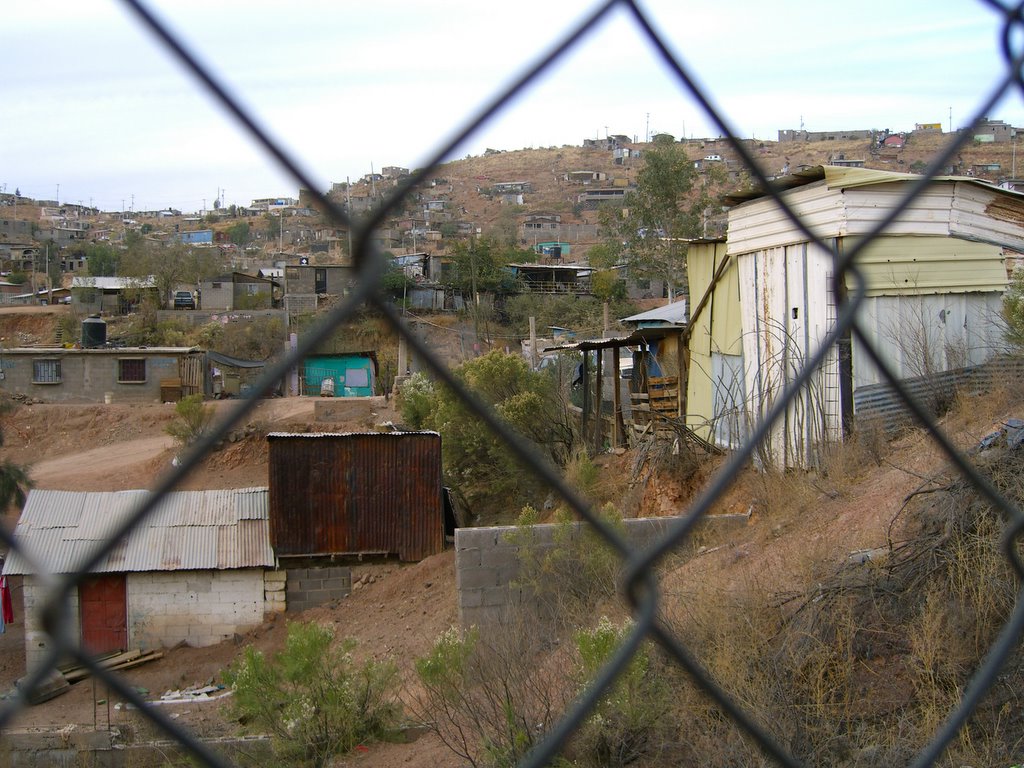
(Homes in a colonia in Nogales, Sonora, Mexico, Dec. 2005. Many residents are employed but wages are not enough to afford adequate housing.)
The elite in the Philippines may favor this race to the bottom, but as noted, Philippine society will become brittle. Metro Manila has about 40% of its residents living in squatter settlements. The U.S. embassy alone processes about 500,000 visa applications yearly. Just think, one in eight Filipinos now live abroad. I am not calling for a forced redistribution of wealth, but for Filipinos to have more opportunities to generate wealth for themselves. If not, the economic diaspora will continue and the ones left behind will be the angry poor, the vulnerable, the politicians, and their lackeys.

My last point is this. OFW remittances are reportedly $10 Billion for 2005. Where is this money being invested in? It is usually in real estate, consumer items, and pseudo investment schemes, usually pyramid schemes. This is another disservice to our OFWs. They need to have more investment options. Filipino entrepreneurs need to be more creative and bold and offer something more to OFWs. As one noted, if we had basic industries, then maybe OFW remittances could be a cheaper source of capital.

Living wages are under attack worldwide. This is one of the great intellectual and moral debates at present. How do we, as a society, want to proceed: a race to the bottom ala China/Wal-Mart or through a genuine partnership among different sectors of society to uplift the living standards of ALL Filipinos?

I wouldn’t pin my hopes on the government initiating Hyperwage. I would rather follow the Gawad Kalinga strategy of establishing a track record of private sector initial successes, partnership building, transparency, and accountability so that when the time comes to deal with the government, we deal from a position of equal footing.

We need to be more creative and bold in leveraging our freedom (while we still have it), skills, experience, and network in this pursuit.
Happy 2006.

Monday, November 14, 2005

Comments on Jesuit guidelines on Philippine political crisis

Comments on the the Jesuit guidelines on the Philippine political controversy:

1. Bringing out the truth cuts both ways. It is a given that we all should work at finding out the truth. In the meantime, GMA is presumed innocent until PROVEN guilty. GMA critics charge her with election fraud based on a wiretap. Wiretapping is illegal in the Philippines. So, there are two possible illegal acts here, the alleged election fraud and wiretapping. We need to know the facts regarding this illegal wiretapping because this has serious implications on our civil liberties and the Machiavellian way of assuming political power. If it could happen to the President then it could happen to any citizen, and even worse, the vulnerable and weak in society. This is a serious implication, which the "progressives" in civil society, academia, media, church, etc. are silent on. This is a terrible omission on their part.

2. Justice is multidimensional. Seeking out the truth is only one aspect. Another important aspect is procedural justice, which is the process of arriving at the truth, reaching a decision, and acting on the decision reached. The election fraud charge could have been resolved by: a) GMA resigning, b) another People Power or coup det'at, and c) impeachment by Congress. Options a and b were rejected by GMA, which is her prerogative, by majority of the Filipinos (no People Power), and the Armed Forces respectively. Impeachment was the logical, next, and most feasible alternative. However, as a friend observed, the opposition Congressmen who led the impeachment/prosecution panel were also the ones in charge of the defense of ERAP during his impeachment proceedings. On both occasions, they bungled the job (despite their educational credentials and their dominance in Congress during ERAP's presidency). Let's face it, impeachment is both a legal and political process. If the opposition and their allies had a weak case, they should not have hurriedly filed the impeachment complaint and should have prepared better. The Filipino people are not stupid and will not confuse legal and political ineptness on the part of the opposition with the administration's political machinations.

There should be a way of proving GMA cheated AND finding out who authorized, organized, funded, and conducted an illegal wiretap without sacrificing the economy. All these, not only GMA's ouster, should constitute the fixed pie of justice in this case.

3. Headless opposition. As FVR noted, GMA may not be our ideal president, but there are currently no alternatives in the opposition. The opposition is headless, disorganized, inept, and lazy. They are also vulnerable. Cory, aside from being retired, has her Hacienda Luisita agrarian reform and massacre debacles (including the killing of union leaders). Bro. Eddie has his Zoe TV station legal woes. Drilon and Dinky Soliman are being attacked for their insincerity. The Senate is so unproductive that I am amazed that they are not ashamed of it. Drilon and the UP Law Center charged GMA of graft and corruption on the Northrail project, a critical transportation project for Central Luzon, but they misidentified the Chinese proponent-corporation. Nestle, which Ex-DTI Sec. Santos headed previously, is tainted by the killings of Nestle union leaders. Ping Lacson is in trouble because of the alleged kidnapping, murder, and drugs accusations, and possibly espionage in the U.S. because of his protege, Michael Ray Aquino. Makati Mayor Binay is hindering business activity in his own city by co-organizing allegedly paid-for rallies. The Makati Business Club calls for GMA's resignation without consulting its members, while its Executive Director is allegedly a Canadian citizen. Congressmen are concerned more with their pork barrel and political dynasties. The Left, well, what can I say?

Do you think that persons and groups of contradictory political persuasions, who are now united in their attempts to oust GMA, will be able to solve our political and economic problems? They are their own worst enemies. The Philippines has been spared from catastrophes this year, but not the biggest catastrophe of all- inept and lazy professional politicians and amateur politician wannabes.

4. Debate now. The Constitutional debate is not being rushed. Discussions started almost immediately after the implementation of the 1987 constitution when various sectors of society began noticing the negative impacts of some aspects of the constitution. During FVR's presidency, the debate heated up. Many think it was bad timing because it would've favored FVR, but hindsight now provides us with the regret of an alternative future. The point is that on every occasion the possibility of amending the constitution was raised, select groups immediately opposed it. Why are those who profess to work for democracy so adamant against discussing and debating constitutional amendments? Shall we let this opportunity for constitutional amendment (and possibly shortening GMA's rule) pass? A parliamentary form of government is not a panacea to the nation's ills, but it addresses an important structural aspect of a country's developmental strategy- the political and legislative sector. Again, as FVR noted, a parliamentary form of government also provides for the development of leaders from all sectors of society; since it is cheaper to gain political power. Vested interests are not the monopoly of GMA and her allies, it seems.

The future is uncertain with globalization, "war on terror" (??), and "natural" disasters (actually natural phenomena affecting human settlements). Self-defeating politics are only an added misery. Too many people in the Philippines and in the world live in poverty. In the U.S., living wages are declining so working here will become increasingly difficult. The same may be true in Europe. If the Middle East autocrats don't shape up and their oil runs out, their economies may not be resilient enough to hire more migrant laborers. While economic migration is now the norm for a number of us middle class, middle-aged Filipinos, it is developing the Philippine economy that will enable us to live meaningful lives at home. We need to tackle poverty everyday and not let the politicians waste our time entertaining us with their clownish behavior. The poor are desperate and poverty is one antecedent to political upheavals and violence. While we have been weathering the external shocks of the 1997 Asian financial crisis, ERAP and GMA?, oil price increases, etc., a catastrophe such as a massive earthquake, another Pinatubo, a tsunami, drought, or a pandemic hitting a populated area could easily send the country in to chaos. All it takes is one massive "external" shock. Are we prepared?

I suggest reading the Hyperwage Theory of Thads Bentulan/Streetstrategist at the Businessworld on how to tackle poverty (I have parts 1-26 on e-file).

Office of the Provincial
PHILIPPINE PROVINCE SOCIETY OF JESUS
TO THE WHOLE PROVINCE
Re: Endorsement of GUIDELINES IN A TIME OF CRISIS
To Jesuits and Jesuit Institutions of the Philippine Province
With this letter, I endorse to all Jesuits, Jesuit communities and Jesuit apostolic institutions of the Philippine Province, the attached Guidelines in a Time of Confusion and Crisis, produced by our Province Commission on the Social Apostolate. These Guidelines, produced after much discussion and consultation, are an attempt to provide Christian moral reflection on our present national situation of political crisis and confusion.I ask that these Guidelines be read, reflected, and prayed upon, and made the subject of serious discernment, towards action, by individuals,communities, and institutions. They may be shared with others who are seeking direction and guidance in our troubled times.I know that not many will agree with what is presented here: some will judge that the Guidelines go "too far;" others will doubtless think that they do not go "far enough." For my part, I personally believe that these Guidelines offer sound directions to help us "read" our present situation and to orient us in our common search for authentic solutions to the grave problems of our country today. Nonetheless, these Guidelines are not presented as positions that all are compelled to accept and adhere to. If some, in conscience, differ with the positions taken here, let that dissent be presented with civility and intelligence, as input for the continuing task of communal discernment towards what will serve the true good of our country.Let us be united in prayer and deep concern for our country and our people. May the Lord show us the way toward the truth, freedom and justice that our people yearn for. May God bless us with courage and hope.
Fraternally in our Lord,
DANIEL PATRICK L. HUANG, S.J. (sgd.)
Provincial
SOME GUIDELINES IN A TIME OF CONFUSION AND CRISIS for Jesuits and Jesuit Institutions of the Philippine Province
1. The struggle to bring out the truth must go on. The freedom to advocate this struggle must be upheld. The President has not sufficiently rendered an account to the people where serious charges have been raised against her, and efforts to hide the facts only confirm the suspicions of many. Todismiss the concern for truth in the name of stability is to condone the culture of impunity, by which those in power have long been able to commit crimes unpunished, and our people have become cynical - accepting corruption and deceit as normal in our public life.
2. Those who claim that the "rule of law" was triumphant in the recent impeachment proceedings confuse proceduralism with law. While it is true that the procedures of law were fulfilled, the spirit of the law was subverted. Evidence was not allowed to emerge.
3. Peaceful and legal means that protect and strengthen our democratic institutions must be used in the continued search to bring out the truth. In this same spirit, the legislature, especially the Senate, must not be remiss in its oversight functions, to ensure the system of checks and balances setin place by the Constitution. Likewise, care should be taken that concrete actions do not support or strengthen groups with covert anti-democratic, adventurist, or power-grabbing agenda.
4. We respect the decision of those, who, in conscience, have reached a judgment that the President should not remain in office. Part of this process is the moral obligation to seriously consider alternatives that will be truly for the good of the country, and not abet the struggle for power among elite and corrupt politicians.
5. The search for the truth must include a search into the deeper truth of Philippine political life, the factors which make the present crisis just one of a series of political crises that hinder the country's development. It is necessary to listen to, reflect seriously on, and address the concerns of a large majority of people who seem apathetic or whose dissatisfaction does not seem to translate into political action. Some, for example, have lost trust in all politicians, of whatever camp. Others, especially those in the provinces, feel excluded by and resentful of what they perceive to be Manila deciding for the country again. Efforts must be made to address this disillusionment and sense of exclusion, so that our people might be motivated to participate more vigorously in our country's political life.
6. If many of our people seem to be uninvolved or uninterested, it is primarily because of an overriding concern for economic survival during very hard times. The real and urgent concerns of the poor should be given highest priority amidst all efforts to search for truth. Indeed, the search for the truth is integrally linked to the fate of the poor. Corruption and dishonesty have made the lot of the poor worse.
7. Programs and initiatives from both government and the private sector to address the urgent needs of the poor, in fields such as education, health, housing, livelihood, and the like, should continue to be supported,and indeed intensified. This is especially urgent in view of the looming international oil crisis.
8. While there may be reasons to consider amending the constitution for the sake of greater responsiveness to the needs and aspirations of our people, charter change as a diversionary tactic in times of political conflict, or as a means of perpetuating elite democracy, should be rejected. Thus, the rush to change the Constitution, especially through a Constituent Assembly, should be resisted. Furthermore, while major constitutional changes such as parliamentarism and federalism may seem to have merit, their concrete realization and implications should be carefullystudied and discussed, rather than prematurely decided upon.
9. There may be no clear solutions or exit strategies to our present state. But our past history, especially during the Martial Law years, reminds us that we can continue being vigilant and work for truth and justice even when the alternatives are not clear.
Thus, the following courses of action should be pursued:
a. Our educational institutions, parishes and other institutions should become centers for conscientization. Discernment groups must be organized, to combat apathy, to heighten awareness and involvement, and to prepare for future action. We echo the call of the CBCP in their statement of 10 July 2005, to "urge our people in our parish and religious communities, our religious organizations and movements, our Basic Ecclesial Communities to come and pray together, reason, decide and act together always to the endthe will of God prevail in the political order."
b. Conscientization that leads to organizing and reorganizing base groups and forming community or sectoral organizations should be given priority. Such groups can also be invited to deal with local problems, to engage local government, and to do network-building with other sympatheticgroups.
c. These and other groups should be mobilized towards vigilance, monitoring:
· first, the continued effectiveness of government programs for the poor;
· secondly, appointment to public offices made by the President;
· third, acts of apparent retribution against those who are critical of the government and the President;
· fourth, the actual use of pork barrel by legislators and their possible abuse of it for themselves;
· fifth, the preparations for forthcoming electoral exercises, through advocacy for automation, and the continuing task of voters' education;
· sixth, the use of funds that will be made available in the event of a Peace Agreement in Mindanao.
d. Deeper study and reflection on institutional alternatives (such as parliamentarism, federalism, etc.) should be conducted at various levels, from university think-tanks to grass-roots groups.
SOCIETY OF JESUS, PHILIPPINE PROVINCECOMMISSION ON THE SOCIAL APOTOLATE
Albert E. Alejo, S.J.
Miguel B. Lambino, S.J.
Jose Cecilio J. Magadia, S.J.
Antonio F. Moreno, S.J.
Karel S. San Juan, S.J.
Primitivo E. Viray, S.J.
Peter W. Walpole, S.J.
Roberto C. Yap, S.J.

Tuesday, October 04, 2005

comments on hyperwage theory

I don’t have the technical answers to questions raised about Hyperwage Theory, but below are some perspectives.

1. The strength of an economy is a function of, among other things, the level of industrialization and purchasing power of the citizens. That’s how the G7 countries and tiger economies, i.e. S. Korea, Taiwan, etc. made it. They industrialized and protected their infant industries until they were able to compete. At the same time, wages were living wages, so the employed citizenry were able to buy needed goods and pay for services. They also bought local. Culture trumps all. We all know this but it is good to keep it in mind.

2. Economists have foisted upon us the myth that their economic data are accurate and importantly, up-to-date. Unfortunately, this has not always been the case as data gathering is very difficult, costly, and time-consuming. Economists also rely on data that they did not themselves gather, so the data are questionable. All of the social sciences struggle with the twin problem of data gathering methodology and data validity.

What this means is that it is difficult to get some mathematical formulation that will fully support the Hypwerwage Theory. Besides, the other popular economic theories and schools of thought were implemented with even far less mathematical justifications, i.e. classical econ, macro econ, neoliberalism, state socialism, etc.

3. What businessmen, such as many of you, have done is that you have relied more on buying behavior, the market, pop psychology, and trends. That is why books like the Tipping Point, Butterfly Economics, and now Freakenomics (I’ve read the first 2) are widely popular and counter-intuitive. It is how people spend their money (marginal subjective utility) in a manner they personally feel is best utilized. Successful businessmen and entrepreneurs are those who discern this market/ subjective utility. The Hyperwage theory posits that it is prices that determine market behavior. But the “pricing behavior” is basically individual wants and needs which influence others’ behavior. This is then eventually scaled up to the societal or market level.

4. One way of looking whether Hyperwage will work has been written about already, the example of Ford raising his employees’ wages so they can buy the Ford T. Don’t think that this has not been done in the Philippines. One reason why Ayala Land is successful, aside from its good management, is that employees buy Ayala Land properties. They sell in-house and sell a lot. It and many other companies have what is called the employee-discount plan (all the U.S. car companies are doing it). Where do you think SM employees shop? Where do insurance and educational plan agents buy their plans? So, good wages and employee discount will generate in-house sales especially if you are selling GOOD QUALITY consumer items with good service (best management practices still count!).

5. The other point is the emergence of a major market segment that nervous local businessmen do not realize that they actually have been selling to. This is the OFW market. One out eight Pinoys are out of the country presumably earning, presumably remitting ($6-8 billion/year), presumably spending back home (a lot of assumptions here). Hey, we Pinoys spend $50 million yearly alone on U.S. visa applications. What does this imply?

5. 1 OFWs are becoming the middle class because of their higher wages.
5.2 They are re-investing and spending somehow in the country.
5.3 There is some multiplier effect on the local economy.

Who is earning from OFW spending? Astute businesses benefiting from hyperwages. Now, the truly creative part is getting the rest of the population to start buying (and selling!!!) more.

6. In the long-term, the government needs to give enough opportunities to Pinoys to be the best they can be. Given the right breaks and better governance, I believe Pinoys will choose to industrialize (in an environmentally-friendly manner) and provide even better wages. While the G8 countries are an inspiration, we will have to develop in our own unique way. Free trade has been bad for us, because we should’ve negotiated for FAIR trade. The OFWs are giving us another chance, but we all need to pitch in whatever way we can. We all need to support Pinoy businesses- and labor.

7. My thesis though is that it is futile to put our national economic salvation in our politicians and bureaucrats. I posit that due to their vested interests, they will never be able to reform by themselves. They must be forced to. Marx said it himself when he noted that bureaucrats have turned themselves into a class unto themselves in direct competition with the other social classes.

So, if we pin our hopes on reforming the bureaucracy/politics; then it will necessitate a bloodbath. Are we willing to do this? There are about 1.5 M government employees exclusive of the politicians. Where do we start the eradication? My brother-in-law, an American, says we go top-down. Ok, I said, why don’t we start with GMA’s kamag-anaks, relatives, classmates, then move on to the Congressmen, Senators, and their families and friends? Where does it end, I asked him. Do you think these powerful people will take it sitting down? It will be a bloodbath.

8. A few months ago, these same questions were raised by former Ramos NSC advisor, Gen. Jose Almonte (he correctly predicted in 1998 that if ERAP won the presidency there would be a coup d’etat or some sort of uprising in 2 years) and UP/PhilStar’s Alex Magno. Their conclusion? The market is the only feasible way of instituting reform. They said a bloodbath would be too costly for the nation and that “millenarian groups” (ideological bent can not be determined but might be of an ultra-fundamental religious leaning) would have a good chance of taking power. The country would then enter into a cycle of violence and become a failed state. I think Hypwerwage provides one pillar of support for their market-as-solution proposition.

9. The Philippines has been recognized in the academic literature, in the international social movement, and in the global human rights community for its contributions to democracy, people power, etc. Some writers are beginning to note that the effects of globalization and how to address some of its ill effects have come from Philippine civil society initiatives. Philippine environmental and community-based projects have been winning accolades. They also predict that the Philippines will also be able to come up with a way of solving its economic problems in a democratic manner. I think this could be done through generating wealth or as Almonte and Magno write, through the market and through Hyperwage.