Monday, September 22, 2008

Entrepreneurship opportunities, both capitalist and social, in the Philippines

Escaping the scorching Arizona heat, visiting family and friends, and continuing my research on Gawad Kalinga, led me to Manila during the summer. Being the nosy applied anthropologist, I didn’t refuse any invitation to visit GK sites, do consulting research, revisit the great outdoors, and eat and drink with some of the most fascinating people there. In the process, I got updated on what’s going in the country.

The Philippines and the United States have serious economic and environmental challenges. Both have a rapidly widening gap between the rich and the poor. The middle class is being gutted. Migration rates are intense; out of the country for Filipinos and from the rural to urban areas and within urban areas for Americans. As one columnist wrote; “at the rate Filipinos are migrating, we will be left with the poor and the corrupt.” The ecological footprint of Americans due to internal migration, on the other hand, is one of if not the highest in the world. The financial, insurance, real estate (FIRE) sectors characterize both economies. In the United States however, the sub-prime mortgage debacle is threatening its, and possibly the global, financial system. For the Philippines the OFW remittances, which is fueling the real estate boom and the import-laden semiconductor sector are keeping the economy afloat. Foreign investment in the mining sector and illegal mining are also helping the rural economy in complex ways.

The negatives though are not what I want to dwell on. My conversations with myriad peoples from farmers to miners to bankers, engineers, and yes, even community organizers in both countries, as well as my observations, lead me to believe that there are opportunities for entrepreneurship, both capitalist and social, in the Philippines.

At the outset, let me state that the strength of both countries rests on its human resource. Despite numerous corrupt politicians and bureaucrats and the political-economic crisis, there are many more creative, educated, disciplined, innovative, and energized people and groups that inspire and can convert one into an optimist. Civil society remains strong in both countries. This important resource is the presence of creative and innovative people and groups. One example that I’ve written about are the U.P. Mountaineers who organized Padyak.org, the P500/bike/semester “rental” scheme for U.P. Diliman students that is promoting biking and a healthy-environmental lifestyle.

Media attention and social acceptance are leading to corporate sponsorship, more bikes for students, possible replication in other campuses, rising popularity of biking and increased bike sales. What gets me excited too is that by the second semester, they hope to launch a bamboo bike in partnership with Carolina’s Bamboo Farm. If it passes the trials, we will look for corporate sponsors for at least 100 bamboo bikes. That will highlight the possibilities of bamboo and increase demand for bamboo woodworkers, bike designers, and builders. Do you see the link between social entrepreneurship and the economy?

Outside of Manila, I did some short term applied research on a mining firm and was taken aback at the quadruple shocks that upland, agricultural, mining communities are experiencing. These are; (a) the fuel price increases have increased product transportation costs with resulting inflation; (b) petrochemical fertilizers have increased 300% in the last five years; (c) logging, mining, and extensive upland farming have degraded soil fertility increasing dependence on petrochemical fertilizers leading to a downward spiral; and, (d) lack of irrigation and underinvestment in irrigation facilities make rural farms underproductive. Because of these shocks, upland farmers, at least in this mining area, have abandoned farming and gotten into small scale mining increasing tensions with big mining firms. Local and foreign buyers have entered mining areas and prefer buying from small scale miners, rather than engage in capital-intensive mining.

While these external shocks are indeed shocking, there are underlying opportunities. First, probable high permanent oil prices are increasing demand for alternative fuels and energy sources. AltEnergy Systems Inc. of Chips Guevara reverse engineered and adapted to Philippine driving conditions conversion kits that enable diesel vehicles to run on used cooking oil. The conversion kits cost P40,000 each and cut by more than half the daily fuel cost of, for example, a jeepney driver. He is also setting up the fuel supply chain by buying used cooking oil and filtering it, while establishing pilot jatropha farms.


For gasoline vehicles, GreenFuel is a newly established LPG conversion company. For also about P40,000, ANY gasoline vehicle can be converted to run on gas and LPG. LPG is cleaner and better for gasoline engines. It is also roughly half the price per liter of gasoline. LPG refilling stations are beginning to sprout.

Note that in 2006, there were 5.33 million registered vehicles in the country.

LPG kit on a late model Toyota Camry

While we discussed technology at the retail level, the question of fuel supply needs to be addressed. Now is a good time to invest in farming and/or reforestation that produces alternative fuels. These include coconut oil, jatropha-sourced biofuels, and other indigenous plants and trees that can produce biofuels. The barriers are land, capital, and labor. A people’s association (PA) in northern Luzon showed me how to do it. It took them years to apply, but they were successfully awarded a 1,000 hectare community-based forest stewardship agreement (CFSA) by the DENR. DENR then linked them up with a foreign technical investor (FTI) that trained them on how to establish a jatropha farm. It is paying the salaries of the farm laborers,. It commits to bring in the harvesting and fuel processing equipment. Lastly, it will give at least 10% of the biofuel sales to the people’s association. A nursery has been established and planting is proceeding. It’s a win-win for the FTI, the PA, the environment as denuded slopes are being replanted, and the upland economy. This should be the model for an agroindustrial-environment entrepreneurial program.

Many more CFSAs exist. What are you waiting for?

The third is food security. The government, private sector, and civil society need to invest in irrigation and fertilizer production, preferably organic. One model I saw involved a carbon credit company I’m involved with. Hog farms are constrained by pollution charges, high power costs, high feeds, and high waste management costs. This company provides the technology and financing that will capture the greenhouses gases, which it sells as carbon credits. Everyone wins. The hog farms gets a biodigester without capital investment, 30% cheaper electricity from the steam produced, a cleaner operation, and up to 10% of the carbon credits. A biodigester system produces fertilizer that farms need and which this company hopes to sell and distribute nationwide. Wastewater is treated and can be reused.

There are at least 30 million hogs in the Philippines and carbon credits sell from $7-30 per metric ton. This is literally making money out of hot air.

There are other initiatives that I can discuss, but I’d like to end this article by discussing the opportunities arising from Gawad Kalinga villages. From an entrepreneurial perspective, GK villages present a labor force and market. GK supporters, partners, volunteers, and beneficiaries are all being educated (in different areas), appreciating various aspects of discipline, organized, and have high levels of communication and coordination (EDOC). Thus, ALL participants can be tapped to be productive. GK villages are an emerging market, especially if the 700,000 homes / 7,000 villages in seven years materialize.

Since one component of the seven-point component of GK is productivity and livelihood, the opportunities are boundless. A productivity program is required of all GK villages. Rural GK sites also have to allot one hectare of the two hectare site for productivity initiatives. A GK village in Taguig has two internet cafes, one sponsored by SMART, the other by Rotary International, an alumni UP class, and an e-commerce start up. Another GK village in Bagong Silang started its own purified water bottling business. A GK village in Quezon is known for its wood carving. Other Taguig GK villages will be tapped to provide the landscaping and waste management services to the rich Ayala villages. A GK village cum relocation site has a working wastewater treatment plant using reed plants that can be replicated elsewhere. The recycled water is pumped into an overhead tank used for firefighting and designed as a welcome arch. A GK village in Rizal borrowed a plot of land from the parish and established an urban organic pick-and-pay farm and fishpond. GK BASECO has a coffee shop using donated Starbucks chairs and tables. GK Reunion Village has an organic farm and nursery, a hotel, guest villas, and a retirement village for GK supporters who want to retire and live near a GK village. The carbon credit company I mentioned earlier is donating a biodigester system to a GK village that will treat kitchen wastes and sewage. The steam generated can power a bakery. The village will now also be able to raise hogs and not worry about waste management. GK and a business school have also sponsored an entrepreneurship competition among its classes in partnership with GK sites. The list of examples goes on. GK has also started to ramp up its productivity and livelihood component with big names in business and finance volunteering their talent, time, and resources. Merchandising is emerging as a feasible productivity sector. A big announcement will be made this October.

GK Reunion Village guest villas

What are the lessons gleaned here, aside from standard business school pointers of market, leadership, drive, financing, strategy, etc.?

One, we need to focus on the needs of the people. There is strong demand for basic household needs of food, water, energy, housing, infrastructure, education, and livelihood. Government and the private sector are not up to par so there are opportunities. Financing needs to be creative to meet these needs.

Second, in working with the poor, provide capital not only for the business, but also to meet the worker’s basic needs. Chips Guevara subsidized the jeepney conversion. He is willing to partner up with anyone, especially jeepney drivers groups, in setting up the supply chain of used cooking oil. The jatropha FTI paid for the training with stipend, hired PA members to do the farming, is funding the establishment of the jatropha farm, and is willing to share profits with the PA in exchange for access to their 1,000 has. CFSA area. The carbon credit company is willing to provide 100% funding, technology, and a build-operate-transfer (BOT) arrangement in exchange for the carbon credits. Gawad Kalinga is promoting entrepreneurship at the village level. It is also inviting entrepreneurs to do business with GK villages and split the profits. When partnering up with the poor or tapping their labor, presence, or time, you need to provide for their basic needs, since the next meal of their family is always in flux.

The poor can be an economic engine and a market. Why not make them a partner in development?

Third, business opportunities, even in a country with dysfunctional politics and political leadership, can arise if the micro-environment encourages a convergence of capital, labor, and technology in a setting of mutual trust and benefit. GK villages provide this setting. The partnership between the CFSA holder and FTI is another. The model of the carbon credit company is further proof. Affordable and equitable provision of financial services including “banking the unbanked” and “providing the last mile of financial services” to the rural poor are needed.

Fourth, investing in lifestyles of health and sustainability (environment) or LOHAS makes good business sense. The market is growing in proportion to the need and demand. Organic food, alternative energy, alternative transportation, urban renewal, ecotourism, etc. are fast growing sectors. An aging population in the United States and the Philippines, coupled with high medical and insurance costs, present the country with retirement and health services that can be at par, yet cheaper than in developed countries. We are looking at least 70 million retiring Americans and at least 300,000 Fil-Ams. Where will they live? What will they be doing in the next ten years?

Fifth, creativity will enable entrepreneurial initiatives that have multiple benefits. The examples above show how organizing the poor address poverty and environmental problems, while contributing to capacity development and empowerment. Creativity, a focus on LOHAS and needs of the people, and convergence zones and situations of capital, labor, technology, spur sustainable development.

Per the insightful economist E.F. Schumacher, initiatives that increase levels of EDOC (education, discipline, organization, and communication) leads to sustainable development as a critical mass stirs the reservoirs of creativity and innovation. The EDOC process itself is an entrepreneurial opportunity. Imbibe culture in it and the opportunities multiply. Padyak.org is a good example. The booming Filipino Martial Arts (FMA) sector in the United States is another one that involves paid teaching, seminars, tournaments, “pilgrimages” to the Philippines, interest in all things Filipino, FMA equipment, t-shirts, videos, etc. The advertising giant McCann-Erickson reported that there are 2.3 million bloggers in the Philippines, at least three million Filipino internet users, most of whom are very active users of social networking sites such as Facebook and Friendster. What does this say about information, communication technologies (ICT) and its opportunities? The call-center, medical transcription, and other business process outsourcing (BPO) business have yet to be fully exploited.

If we can lift the five million poorest of the poor to moderate poverty and assist them to enter even just the lower middle class, we will see a resurgent Philippines.

Profit with honor exists. Try it.

Wednesday, September 17, 2008

Walking in their shoes: The 3rd Annual Gawad Kalinga Walk

"I got you on my back"

Walking is one trait that distinguishes man from other species. By standing upright and walking on our two feet we are able to see farther, travel longer distances, interact, use our hands for other things, discover, and learn new things. Human society is based on language (the ability to communicate and think) and, as the late French anthropologist André Leroi-Gourhan observed, the ability to walk. We walk to get around, stay fit, and relax.

For Gawad Kalinga, walking is one way of being one with the poor.

Last September 6, 2008, 28 cities in the United States and Canada participated simultaneously in the 3rd Annual Gawad Kalinga Walk led by GK’s Maggie Villanueva. This five kilometer walk sought to bring together Fil-Am communities in North America in a solidarity walk for the poor. The GK Walk generated greater awareness of the community development and nation building model of Gawad Kalinga (GK). GK provides Fil-Am communities with a meaningfully way to take up the cause of nation building via loving, sharing, and caring for the poor.

GK Walk also sought to inculcate the uniquely Filipino cultural trait of “bayanihan”- family and friends getting together to achieve something. This entails a foundation of friendship, trust, and cooperation. Walking with one another and for the poor enabled us to make new friends, spend time with each other, and get the family together in something noble and patriotic.

GK Walk Tucson

In Tucson, Arizona, with barely a month of preparation, the Fil-Am community got together for Gawad Kalinga for the first time. Close to 80 persons got up early on a Saturday morning and headed out to the beautiful Gene S. Reid Park in central Tucson to walk for the poor and for friendship. The successful walk in Tucson is significant, because it is quite difficult to get Fil-Ams together on an early Saturday morning to walk five kilometers in this high desert city of 350-sunny-days a year, during a scorching summer. Since Tucson is sprawling, it is also hard to get an agreement on where to hold community activities.


They came for Gawad Kalinga however. Fil-Am groups such as the Philippine Mabuhay Cultural Foundation , the Filipino-American Sampaguita Club of Tucson (FASCOT), the Fil-Am Club of Southern Arizona (FILAMCSAZ), and the Filipino-American Students Association of the University of Arizona (FASA) came together for the first time in a very long time for the GK Walk. We had representatives from at least two charismatic prayer groups and a Filipino priest to bless the participants. FILAMCSAZ members drove 80 miles just to join the walk. A picnic followed the walk with Pinoy Fast Food providing the pancit bihon.


Jessica Cox, a FASA alumnus, the first woman without arms to fly a plane solo, and motivational speaker, led the walk on her recumbent bike. Dr. Avelino Leal of FASCOT escorted her. When you have someone like Jessica and a health buff doctor leading, you end up walking more than five kilometers. I think they were training the participants for the GK Hero's Run (a marathon event)!


Jessica Cox leads the GK Walk in Tucson, Az

In other participating cities, GK Chicago stalwarts Robby and Donna Reyes reported 82 registered walkers and about 150 total attendees. They along with the GK folks in central Illinois led by the indefatigable Dr. Charlie Capati raised a significant amount of money for the GK programs. Panera Bread provided breakfast. They also had another six major sponsors.


Chicago GK Walk. Photo by Dr. C. Capati

In New Jersey, Beth Macaraeg reported that the inclement weather did not deter the walkers. In Tampa, Florida, GK lead Jess Roa noted that the gorgeous weather brought out more than 150 participants including the Associated Filipino Students of University of South Florida. In Boston, Eugene and Evita Florendo reported close to 200 walkers along the beautiful Charles River. They even had an ati-atihan group. They were blessed because their prayers for a stop to the rains and good weather materialized. They were also quite successful in their fundraising.


GK Walk, New Jersey. Photo by Joseph V. Tieng

The Oregon and Seattle GK Walks were well attended. They even had a multimedia presentation on GK and breakfast before the walk. In Milipitas, San Jose, GK point person Alfred Keen reported over 300 total participants despite the 100F temperature.


GK Walk, Seattle. Photo by Melissa

I estimate from 2,800-5,600 joined the GK Walk in the 28 cities in the United States and Canada. Also, quite a significant amount of money was raised. The unquantifiable benefits though, which are priceless, are the conversations held and the friendships newly forged. Fil-Ams are a busy people. A lot of them work at least two jobs, with many doing overtime. Doctors and nurses do extra shifts and are on-call. Most are truly devoted to their families and are active in church and prayer groups. Fil-Am students are busy themselves. Nearly all of them have a full-time school load and work at the same time. On top of this busy schedule are their club and socio-civic activities.


Holy Redeemer Charistmatic Prayer Group

All were happy with the turn out, the diversity of the participants, and the opportunity to socialize with fellow Fil-Ams. The GK Walk showed that Fil-Am groups can get together for the country and for the poor. Already, the walk has led to further networking. The four Filipino priests in Tucson led by Fr. Miguel Mariano and Fr. Les Niez have gotten the Fil-Am groups together to a organize big Christmas dinner of at least 600 Fil-Ams, their families, and friends with the intended beneficiaries being Gawad Kalinga and a seminary in the Philippines. FASCOT wants FASA to help them in manning the Filipino booth in the annual and wildly successful get-to-know-your-neighbor festival, Tucson Meet Yourself.


Filipino-American Students Association, University of Arizona

The GK Walk preparations enabled me to meet the different Fil-Am groups in Tucson. The FASA students were a joy to talk to and work with because of their energy. It’s hard not to be proud that many of them are in cutting edge studies such as biosystems engineering, microbiology, and optical sciences among others. Rev. Virgilio "Jojo" Tabo, Jr. of Our Mother of Sorrows Parish walked the Walk with us and gave the blessings. I even attended a few prayer meetings. In one prayer meeting, I got to meet and hear the insightful talk of new Filipino priest Rev. Mario V. "Ricky" Ordoñez.


Mrs. Inez Cox and Fr. Jojo Tabo

It was Fr. Ricky who inspired us with his advice on prayer;

“Make every breath, a prayer of thanksgiving.”

Tuesday, September 16, 2008

IMAGES IN STONE: Art in Fossils from the Larry Gotuaco Collection

Ayala Museum website banner
Images in Stone-Art in Fossils from the Larry Gotuaco Collection

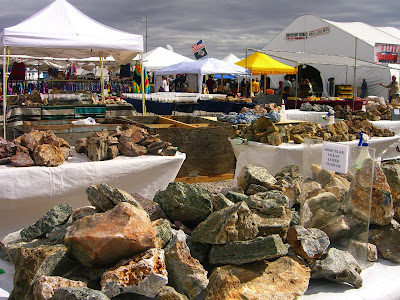
Tucson, Arizona is known for a lot of things, but every third week of January until the second week of February, it plays host to the “Greatest Show on Earth” in the mineral world (Wilson 2004). This is the annual Tucson Gem, Mineral, and Fossil Showcase, going on its 55th year. Popularly known as the Gem and Mineral Show, the Tucson Show, or simply “The Show,” the Tucson Gem, Mineral, and Fossil Showcase has all the elements of commerce, earth sciences, paleontology, archaeology, technology, art, curating, culture, and crafts. Many of the world’s top private collections and public museums have exhibited here. The fellowship, networking and learning experiences generate so much social and cultural energy amidst the high desert scenery of Tucson. To Bob Jones who has attended it more than 40 times and who wrote about its 50 year history in 2004; “it is the “single most important gem and mineral event in the world.”


The Tucson Show is simultaneously a show, museum tour, exhibition, market, bazaar, swap meet, convention, conference, workshop, party, fiesta, pow-wow, food-fest, and tourist destination that brings together over 50,000 unique visitors, collectors, curators, dealers, buyers, scholars, enthusiasts, tourists, students, artists, even hippies to this three-week event. In 1969, then curator Paul Desautels of the Smithsonian Institution and one of the most active supporters of the Tucson Gem and Mineral Show called it “The New York Stock Exchange of the (mineral) world”. Bob Jones quoted him saying “the price of mineral specimens for the world is more or less set at this show.”


If you want to see the latest mineral find, some of the most exquisite gems, or newly unearth mammoths, the Tucson Show is where you should be. Do fossilized dinosaur molars or coprolite (dung) pique your interest? How about petrified wood? Have you seen a meteorite weighing more than 600 kgs.? How much exotic seashells and corals are from the Philippines? Do you want to know and see what ammonites, crinoids, or trilobites are? There is no other showcase like the Tucson Show and it is something an enthusiast should experience even once.


The recent 2007 Tucson Show had 5,079 exhibitors in 49 individual shows, the most ever not counting the unofficial ones. This year the numbers dipped because of the U.S. recession and the housing meltdown that hit Arizona hard. Nevertheless, these shows were scattered all over the city in banquet halls, foyers, and bedrooms/ suites of hotels, convention centers, parking lots, warehouses, or any available space, security permitting. Most shows are open to the public. An economic impact survey-assessment of the Tucson Show by FMR Associates (2007) estimated total gate attendance at 362,816 buyers, each of whom attended an average 6.6 shows. They estimated unique persons attendance at 55,056, the highest ever and 59% more than the 2000 estimated figure of 34,618 persons. Exhibitors came from 42 states of the United States and 38 countries, while buyers came from 43 different states and 24 different countries. If you want to see globalization localized, the Tucson Show will make for a good study.

Economic Impact

The FMR study (2007) noted that the Tucson Show is an economic juggernaut conservatively contributing over $100 million in direct expenditures to the local economy, up from $76.4 million in 2000. Lodging, food/beverage and in-town transportation expenditures alone amounted to $49,549,718. The estimated tax revenue from the show was $9,057,217 in local taxes paid on $90,206,326 of taxable expenditures. This is an increase of 51.2% from the year 2000 figures. In terms of likelihood of return to Tucson, majority of the majority of exhibitors (63%) and out-of-town buyers (78%) indicated that they will return and/or attend the 2008 Tucson Gem Show. These figures do not include the sales and trades made during the three week period. Further, as many of these sales are wholesale, the multiplier effect of retail sales as well as conversion into artistic pieces or jewelry for sale worldwide are not accounted in this study.

The Tucson Gem and Mineral Society itself has long been active in community affairs, which also helps the local economy and education sector. Proceeds from the Show have assisted the Arizona State Museum, University of Arizona Mineral Museum, the Southern Arizona Regional Science Fair, the Southern Arizona Rescue Association, the American Federation Scholarship Fund, the Tucson Special Olympics, the Arizona Boys’ and Girls’ Clubs, the Arthur I. Flagg Memorial Foundation, the Smithsonian Institution, Mineralogical Record magazine and Rocks and Minerals magazine. Significant amounts of money have funded scholarships to the Advanced Studies Earth Science Programs at the University of Arizona according to Bob Jones.

Tucson show in Manila!


From Downright with Ammonites

For the last five years, we’ve been fortunate enough to host our godparents who are avid collectors of fossils, petrified wood, and minerals. This couple, Larry and Pat Gotuaco, of San Francisco and Manila, are well-known and highly regarded in the seashells, Chinese blue and white ceramics, and now minerals and fossils collecting worlds. Tito Larry along with Rita Tan and Allison I. Diem are the authors of the much sought after coffee table book, Chinese and Vietnamese Blue and White Wares Found in the Philippines (1997). After assembling a fantastic collection of seashells and Chinese ceramic, he has now focused his attention on the what he calls “God’s Art.” Afterall, he says, “in Chinese blue and white ceramics you can endlessly debate on the age of a ceramic piece, which is of a time period of a few decades to a few hundred years, but in fossils and petrified wood, we’re talking tens to hundreds of millions of years ago.”


Exquisite ammolite up close from Downright with Ammonites"

What really caught the eye of the Gotuacos on their worldwide search and collection of fossils, minerals, and petrified wood is the natural color and beauty of these specimens. No artist, living or dead, can surpass the color combination, structure, and composition of each piece, whether it is a mammoth’s tusk, fossilized dinosaur dung, or the most colorful Arizona petrified wood. Indeed there is beauty in nature that is simply breath taking. Even the processes of fossilization and petrification, wherein organic matter such as bones, felled trees, or even dinosaur dung get buried in sediment for millions of years, with their organic material eventually being replaced by minerals and silica/minerals respectively, are short of awe inspiring.

These specimens though give you another surprise. Get a camera and take a “macro” or close up shot of a small part of the piece and you see the complexity of colors and structure. It is even more beautiful and majestic.

Words, however, will never be able to describe the fiesta atmosphere of the Tucson Gem, Mineral, and Fossil Show. Worse, words do not let you see and feel what these tens of millions of years-old specimens are.

The Gotuacos though are a very generous couple. They are also stalwarts of experiential learning. Since they started collecting, they’ve always dreamed of bringing the Tucson Show to Manila. They saw the value of an exhibit engendering interest in geology, paleontology, archaeology, astronomy (yes, meteors!), and the natural sciences. Filipinos need and deserve these kinds of learning experiences. Thus, despite, initial setbacks, they managed to convince Ayala Museum to exhibit part of their collection.

Images In Stone

Entitled IMAGES IN STONE: Art in Fossils from the Larry Gotuaco Collection, the exhibit opened on 16 September 2008 at the Third Floor Glass Lane, Ayala Museum and will run until November 30. Workshops are being scheduled for macro photographers and even a kids session on collecting this coming September 27. This is a precursor to the book he is writing on petrified wood.

This is one exhibit the family should not miss.

Give yourself an hour or two for the exhibit. Better yet, give yourself half a day to explore the other exhibits and collections at the new Ayala Museum. The Crossroads of Civilization is a must see. For the politically inclined there is the I am Ninoy exhibit.

Bring the family, learn something new, and learn more about your country.

Wednesday, September 10, 2008

Country First! But, whose country and who first?

The Republican National Convention (RNC) held last week did not fail to intrigue and pique the interest of Americans and the worldwide audience. They certainly did catch our attention. After the resounding debut of Barack Obama and Joe Biden at the Democratic National Convention (DNC), the RNC scuttled their first day because of Hurricane Gustav. The announcement of Alaska Governor Sarah Palin as the vice-presidential nominee the Friday before carried them through though. Gov. Palin was a new and pretty face, a hockey mom, feisty, and charming. Pending further vetting of her, she is a fresh face for the Republicans beset by the chaos in Iraq and Afghanistan, the lingering tragedy of Hurricane Katrina, the housing implosion, the economic recession and accompanying “mental depression”, and the health crisis. Republicans, observed the New York Times’ columnist David Brooks, entered the RNC practically morose.


The Republicans, like the Democrats, promised change and reform. This they hope to accomplish via three primary strategies.

The first is a change of Republican and, hopefully, national leadership anchored on the man once called the “most trusted man in America” and now a “maverick,” Arizona Sen. John McCain. He will be backstopped by the charming, full of energy, and emerging symbol of the Republican woman, Gov. Sarah Palin.

The second is that, with a focus on the track record and character of both candidates, they will reform Washington and overhaul how politics is practiced.

The third is a renewed emphasis on patriotism and increased security. It is about confronting perceived American enemies anywhere in the world to ensure the country’s security from terrorism. In other words, the “war on terror” will continue.

If the objective of the RNC was to re-energize and rally its base (of supporters), this they accomplished. Sen. McCain attracts the security-conscious voter, while Gov. Palin brings to the table interest, intrigue, and an appeal to the woman vote. What we will see is a United States that will vote on the fault lines of race, gender, class, and socio-economic issues.

In deconstructing the Republican message and their policies based on the speeches over several days, the elements were similar. My comments and that of others follow below.

The focus on the biography and heroism of McCain was smart, because it detracts from the failings of the Bush administration of the last eight years. The goal was to put enough distance between him and the Bush administration. To further emphasize this gulf, they pulled a surprise in presenting a VP candidate out from literally nowhere, Wasilla, Alaska that is. It was a risky move characteristic of McCain the maverick.

After this spectacle of surprises, what comes next? Their message was that character and a track record of heroism is needed to reform Washington. I find this hard to believe, since the base of supporters and funders of the Republicans espouse policies that will ultimately and literally, fry all of us.

Rudy Giuliani’s “Drill baby drill”, his roguish laughter, and his cheerleading of the RNC participants as they repeated the chant were chilling. He, other speakers, Gov. Palin, and finally, Sen. McCain followed this up with a commitment to re-start the nuclear power program. They actually believe that the road to energy independence includes drilling for more oil and nuclear power.

I foresee global warming and a mushroom cloud.

Drilling for oil in the U.S. is full of myths and disinformation. See “Four offshore-drilling myths” by Eoin O’Carroll. Basically, there isn’t much oil left and what’s left is too deep and expensive to drill. Oil is a finite resource. In finance, oil is the equivalent to capital . You shouldn’t be using up the capital, just the interest. Where is energy and fuel conservation? Raising vehicle fuel standards? Where is government, in Thomas Friedman’s words, in reshaping the market to encourage renewable energy and alternative fuels?

The issue with nuclear power is nuclear wastes have a lifetime of thousands of years. Except for the Church, no institution has survived thousands of years to manage these nuclear wastes. Who would be reckless enough to leave to future generations the responsibility of taking care of wastes that can cause the extinction of the human species? All that for the privilege of consuming more, making the nuclear power industry rich, and avoiding conservation measures? Lastly, there are embedded risks in nuclear energy because of its complexity and life cycle (from mining to processing, use, and waste disposal) that have been expertly dissected in Charles Perrow’s classic Normal Accidents .

In a RNC dubbed “Country First” with an emphasis on veterans, McCain’s heroic war record,and patriotism, fighting was the code word. McCain himself used the word “fight” at least 25 times in his acceptance speech. Either his statements will vault him to the presidency or condemn him as the proponent of a culture of death and conflict. As he said; “Fight with me…Fight for what’s right for our country…Fight for the ideals and character of a free people…Fight for our children’s future….Fight for justice and opportunity for all…Stand up, stand up, stand up, and fight.”

Apparently, the police and authorities took his exhortation to fight literally. While there were anarchists who caused trouble, police brutality against varied protest groups were extensively documented. At least 400 were arrested for the flimsiest of reasons, journalists hurt, and scores of protesters maced and clubbed. The mainstream media hardly covered it, but the gory details can be found on-line. See Vital Source for a round up on the violence during the RNC. Photographers documented and wrote about police abuses. Journalist Amy Goodman, herself arrested and manhandled, recorded the Ramsey County Sheriff using infiltrators in the protest marches.

The last is on security and the never-ending “war on terrorism.” Despite the debacle in Iraq and Afghanistan with hundreds of thousands dead, including innocent civilians, thousands of dead and wounded American soldiers, a monthly $10 billion bill, what has the United States accomplished? Two failed states and millions of angry relatives of the dead and tortured. An American economy that is being bled dry because of military over-reach. The question still remains, who is the terrorist? If the terrorist is STATELESS, why engage in a conventional war?

This “war on terrorism” has proven profitable for those engaged in what former President Ike Eisenhower called the military-industrial complex. Only a few companies actually benefit, with the nation taking on a terrible burden. Growing the economy through endless conflicts doesn’t seem like good business sense.

Lastly, are Americans really being threatened by other nations? Iran, North Korea, Venezuela are touted as rising threats. This shows little faith in diplomacy and the American military. Did you know, the United States has 761 military bases across the planet? Really, is there a country willing to take on the vast American imperial military? If terrorism is a problem, use counter-intelligence, diplomacy, and police work. Development, not warfare, is the best strategy of “draining the swamp” of terrorism.

My observation is that all candidates have the character, integrity, and dedication to lead the nation. What separate the chaff from the grain are the policies.

Who presents a vision of the future of investments in renewable energy, education for all, affordable health care, safety nets for the poor, rebuilding of the economy, and those espousing sharing, caring, peace, and a concern for the environment? Who presents a vision of the USA as a moral leader, quoting Bill Clinton again, leveraging “…the power of our example than by the example of our power?”

The American people will be voting for their future this coming November. What kind of change will it be? Will it be one based on hope and values or one based on more of the same?

For Fil-Ams, they need to seriously reflect on who they support. Like the DNC, they were invisible. Worse the RNC was a pale affair. How can RNC hope to reform and change the course of this complex country with only one race? See Washington Post’s article on the lack of diversity in the RNC.

Many Fil-Ams or their parents fled the Philippines mainly because of the lack of economic opportunities. They need to support candidates who are sympathetic to economic migrants. Importantly, they need to support candidates who work for the reduction of income inequality, strengthening of the middle class, and engage minorities. To support candidates that DO NOT support these initiatives, Fil-Am voters only become like the politicians and caciques that they escaped from.

The future is in your hands.

Monday, September 01, 2008

Yes we can! at Mile High

Last 28th August, St. Agustine’s Day, was historic not only for the United States, but possibly for the world. Barack Obama, son of a Kenyan scholar father and a white anthropologist mother from Kansas, became the first nominated person of color to run for the presidency of the United States. He accepted the nomination in front of over 80,000 people and tens of millions of TV viewers at Invesco Field in Denver, Colorado. His 45-minute acceptance speech capped a nearly week-long Democratic National Convention that featured some of the best political speeches in recent times. If these speeches, tinged with wit, emotion, passion, common sense, and filled with hope, dreams, and determination, were made in 2004, the course of U.S. affairs since then may have been vastly different.


But as with the United States, the American people are a resilient people. This year they have another chance to change their state of affairs. I believe that they will in a fundamental and historic way with the election of Barack Obama. Indeed, to use the overused cliché, these are going to be very interesting times.

Nearly 200 people spoke during the four-day convention. Many if not most of the speeches were emotional, if not passionate. A few themes ran across the speeches. The first and most important, which was capped by Obama, is that America is about dreams and the fulfillment of dreams. To the speakers, that is what America is all about. That is why migrants risk everything to go the United States. America is about a new start, where the impossible is possible, where hope can become real. In America, your family name and origin are not liabilities. You can be the best you can be. Work hard and you can achieve your dreams. Ted Kennedy stressed it best; "The work begins anew. The hope shall rise again. And the dream lives on."

The second is that in a world of constant change and at many times, conflict, America needs to exercise a leadership that is not unilateralist. Bill Clinton highlighted this in stressing why Obama is the right choice. Unilateralism is really a code word for bullying and in recent years, the United States has been anything but unilateral. The result is that the country has lost worldwide influence and prestige; engaged in a disastrous occupation of two countries; caused hundreds of thousands of deaths and injuries; and made more enemies. It is oxymoronic for the last remaining superpower in the world to use force, when diplomacy, development work, and police-intelligence/ counter intelligence work are the better options in addressing terrorism or combating STATELESS adversaries. Bill Clinton said perfectly; “People the world over have always been more impressed by the power of our example than by the example of our power.”

The third theme was about change. The change that the speakers spoke of was change based on family and the values of honesty, hard work, principles, ethics, sharing, and caring, and faith. Michelle Obama, Ted Kennedy, Caroline Kennedy-Schlossberg, Hilary Clinton, Beau Biden, and Joe Biden, among many others stressed this. The powerful must be grounded on what the people are experiencing; what families are going through. Because it is in spending time with Americans all over, importantly those struggling, can leaders know what needs to be changed. As Obama said, “Change doesn’t come from Washington . . . it comes to Washington.”

The differences between the parties are striking. Obama comes from a multicultural background, which is indicative of tolerance. He knows poverty from personal experiences of growing up and from working on it. Michelle Obama’s message was clear; "We want our children and all children in this nation, to know that the only limit to the height of your achievements is the reach of your dreams and your willingness to work hard for them."

Biden’s personal tragedies and his commitment to his family and community keep him grounded, with a commitment of no cronyism. As Biden said; “For every American who is trying to do the right thing, for all those people in government who are honoring the pledge to uphold the law and honor the Constitution, no longer will you hear the eight most dreaded words in the English language: The Vice President's Office is on the phone.".

Democrats favor research and investment in renewable energy, while the other party favors drilling in ecologically sensitive areas. They look at the immigration issue as a wedge issue that detracts from its economic causes, which need fixing. Obama’s “Yes We Can” parallel’s Cesar Chavez’s “Sí, se puede.” Social justice and compassion are what are lacking in the immigration debate. They favor talking and negotiating, rather than force as a blunt tool of negotiation.


Lastly, the Democrats’ message is one of HOPE. Hope energizes. It is about optimism. It is about faith and the virtues of sharing and sacrificing. The byline of fear and scare mongering, I believe, has run it last course. You can only scare people for so long to stay in power. After that, the game is up. Hope will prevail.

The Republican National Convention started with the stark reminder of Hurricane Katrina and the incompetence of the political and executive leadership three years ago. They should have consulted a feng shui expert as Hurricane Gustav hurtles toward Louisiana and New Orleans. This has forced them to reorganize the convention and cancel the speaking engagements of Pres. Bush and VP Cheney. This may bade them well, but it only highlights the reactionary actions and nervousness that abound.

There are reasons for optimism for Democrat supporters after the DNC, but the road to the White House will be narrow, rocky, and full of landmines. It will entail hard work, dedication, sacrifice, consistency, and importantly, integrity. Democrats are running on a message of CHANGE and HOPE based on VALUES and ETHICS. They must live it everyday.

For Fil-Ams, why where they invisible in DNC? Why no speakers? The interests of the Fil-Am, if not Asian-American communities, lie with the Democrats. There are initiatives such as Filipinos for Obama, but the silence and invisibility of Fil-Ams are troubling.

Monday, August 25, 2008

Saan Ka Nakatira? Ano ang ginagawa mo?

GK Pandi homes, June 2008

Saan Ka Nakatira? Ano ang ginagawa mo? Where do you live? What do you do?

These two questions define who you are and what your identity is. These two questions either bring you confidence or shame, hope or despondency, contentment or anger. “I live in (fill in the blanks) and I am the father/mother/brother/sister/son/daughter of (fill in the blanks). I am a (fill in the blanks)” define who you are on so many levels, be it gender, class, status, or other cultural markers of age education, and, work. As E. F. Schumacher noted, work enables man to develop and use his talents to meet his needs in a way that builds community and solidarity. The poor though have neither a voice nor a stake in society because they don’t have meaningful work that meets their needs.

Imagine if you were an informal dweller, derisively called a squatter, living a hand-to-mouth existence, with many children, little or no education, no job or underemployed, and in debt. What are your chances of improving your family’s situation in this lifetime? What can you do? Who can you run to for help? Who can actually help you?

A home in the garbage dump of Payatas

What if there at least 2.5 million of you in a metropolitan area? What kinds of conditions do you and your family live in? How do you cope and survive? What options do you have? Multiply this with numerous cities in a country and in every country and you have what sociologist Mike Davis calls the making of a “planet of slums.”

The twin problems of poverty and homelessness, according to Gawad Kalinga’s Tony Meloto, are so massive that neither government nor the private sector can solve it alone. Government and the private sector must come together, along with each and every Filipino, to discover new ways of addressing the causes of poverty in ways that are sustainable, equitable, and which build solidarity.

ANCOP GK\'s Be Part of the Miracle poster

Unsquatting “squatters” is a good entry point in this endeavor. By building homes for them, we rebuild the lives of the poorest of the poor. The dignity of the homeless is restored and he and his family have a secure place to improve the family situation. “Squatters” pay more for basic utilities because of the legal uncertainty they are in. Helping slum dwellers with housing, values transformation, community organizing, health, education, environment, and productivity programs empower them and make them productive members of society. This is what Gawad Kalinga is about.

Coming together requires a setting where friendships can be made. These friendships form the basis for a long-term relationship built on trust, cooperation, sharing, and caring. This context is important because if it is conducive to friendship, then hurts can be healed, faults acknowledged, wrongs forgiven, and changes made. If the rich and poor, powerful and powerless, come together in friendship, then change is possible in the context of “less for self, more for others, enough for all.” This enabling environment for community development is what we all desire.

Many Filipinos and Fil-Ams made the great escape from poverty, graft, corruption, and a generation-long dictatorship in the Philippines to become successful. Either they migrated and made it or they bunkered down and succeeded in a harsh environment. They now need to come together if they want to see a Philippines that is progressive and equitable; a Philippines that is secure, prosperous, and opportunity-laden for their children. They can make it happen. As Gawad Kalinga has been able to provide this enabling environment, Fil-Ams and Fil-Canadians have been coming together and have so far funded 323 of the over 1,000 GK Villages in the Philippines.

On September 6, 2008, Saturday, 26 cities in the United States and Canada will hold the 3rd Annual GK Walk with a theme of ONE Continent, ONE Cause, ONE step closer to eradicating poverty. The GK Walk seeks to generate greater awareness of the GK movement of caring for the poorest of the poor. It seeks to build solidarity and community among the estimated four million Fil-Ams, Fil-Canadians and their American and Canadian friends and relatives. It also seeks to encourage participation in the GK One Million Bayani (GK1MB) and GK Village Builder corps of volunteers/partners.

ANCOP GK Walk poster

To be able to help the poor, we must first become friends to one another.

What better way to start it than through a healthy walk followed by a fiesta picnic?

Check out http://www.ancopusa.org/gkwalk/ for participating cities.

Tuesday, August 19, 2008

Kicking Back with Padyak

Padyak bikes

What is a creative solution to society’s problems? VirtualSalt’s Robert Harris lists the elegant evaluation criteria, summarized as SENC. It should be SUCCESSFUL in solving the problem, overcomes constraints and is acceptable to users or beneficiaries. It is EFFECTIVE in that it is practical, economical, and reliable. It is NEW in that it is original, surprising, and seminal for its further possibilities. It is COHERENT because it is organic, holistic, of high-quality, well-designed and executed, refined, tested, improved, and aesthetic/beautiful.

I would add IBLE to the acronym. The IMPACT is significant in the societal sense. It BUILDS CARING COMMUNITIES. It presents opportunities for individual LEARNING and LEADERSHIP development. Lastly, it creates an ENABLING ENVIRONMENT for all of the above. Thus, a creative solution is Successful, Effective, New, Coherent, produces significant positive Impact, Builds Caring Communities that Learn, as well as Leaders, for an Enabling Environment (SENCIBLE).

Colorful Padyak bikes and artistic discs

The Philippines, being a center of innovation vis-à-vis civil society, has many examples. The Gawad Kalinga GK777 movement easily comes to mind. GK is not alone. In my recent visit to Manila, the Padyak initiative of the University of the Philippines Mountaineers (UPM) is one such SENCIBLE solution to the difficulties of seemingly permanent high fuel prices and a degraded urban environment. The UP Padyak Project was started by UP Mountaineers members and alumni to give back to the University of the Philippines during its centennial celebration. The project is an environmental advocacy that promotes biking as a means of transportation, which helps reduce air pollution, lessens dependence on fossil fuels, and promotes a healthy lifestyle in the UP Diliman campus. As the Padyak-ers advocate, “BIKE FOR U.P. BIKE FOR THE ENVIRONMENT.”

Since the summer of 2008, through funding support of several UP Mountaineers and using the principle of padugo, bikes were purchased and provided to students for a minimal donation of P500 per semester. These bikes are reconditioned, one-speed, have a step-through frame, and are designed for utility and safety and not for speed. About 43 bikes have been purchased, spruced up with lively colors, Padyak bike discs, bike baskets for books, and bike horns. Bike users must have helmets, a bike lock, and participate in a Padyak-sponsored bike clinic. Bike pumps are strategically located within the campus. UPM members and friends have spent at least P200,000 on the bikes, racks, and incidentals.

Padyak bike clinic for bike users

The creativity abounds. UPMers from the College of Fine Arts helped in designing creative bike disks and sculptural bike racks that allow all bike commuters to park their bikes and enliven the campus through public art. Talented artist and UPMer Eng Chan designed and constructed the Pencil, Kalabaw, and Tuyo bike racks which were strategically placed within the campus. Each rack can hold 12 bikes, and occupies the equivalent of one car parking slot. Other members connected with RAADesign, and StrayInteractive designed the colorful bike discs.

Eng Chan\'s \
Eng Chan's Kalabaw rack

A core group led by Eng Chan and UPMer architect Gerry Ramos is spearheading the creation of a bamboo bike in partnership with Carolina’s Bamboo Garden. The bikes will be tagged and named after birds, starting with birds found within the UP campus, per the suggestion of UPMer and philosophy professor, Gerry de Villa.

UPMers Gerry Ramos and Eng Chan with ANOS bamboo at Carolina's Bamboo Garden

Padyak has resonated with many sectors of UP and beyond. Media has covered Padyak with nearly all the major TV stations and newspapers featuring it. The UP administration has fully supported Padyak. In fact, over the summer, it made the academic oval road, not only one way, but one half reserved permanently for bikers, joggers, and walkers only. Padyak has been able to help the security brigade in UP with a commitment to help them fix their broken down bikes. Padyak has opened up opportunities. The bike racks are such a hit that one vendor said that the racks attract more customers to his cart. Bike enthusiasts have volunteered to help repair Padyak bikes that break down.

Several companies are interested in an advocacy and social marketing partnership. The partnership comes with a commitment on their part to donate bikes, while UPM counterparts the bike donation with tree planting activities. The running activist priest and my fellow anthropologist, Fr. Robert Reyes, has bought into the program, donated bikes, and is recruiting fellow UP alumni in Hongkong, where he is stationed now, to support the project.

Padyak is fast evolving. It has grown beyond a UPM Batch 88 anniversary project, with batch members graciously allowing it to become a UP Mountaineers project. Its initial success has generated high demand for Padyak bikes. Padyak organizer, UPMer, and architect Jojo Gutierrez reported that there is now a waitlist of at least 85 students, with more requesting. UP has a student population of around 20,000. Fellow UPMer and sociology professor, Dr. Ging Candaliza-Gutierrez said that even non-teaching staff have been asking her if they can avail of the Padyak bikes.

The \
"Pencil" bike rack

The request is understandable. I never realized how much an IKOT jeepney ride (used to get from one school building to another within the UP campus) costs these days. From a low of 50 centavos in the 1980s, a ride now costs seven pesos. A UP student, on a typical school day, will take 2-4 rides to get to classes in different buildings. Because of its fixed route, an IKOT ride will also take 15-30 minutes each way. Imagine the costs and time wasted by the Iskolar ng Bayan. Padyak doesn’t want to put IKOT jeepneys out of business, but Padyak complements IKOT and will hopefully encourage IKOT jeepney drivers to evolve.

Mt. Everest summiteer and UPMer, Romy Garduce, posing for Padyak

Padyak hopes to encourage other groups, especially corporations and schools/universities to start their own Padyak programs. Padyak afterall promotes the use of the most efficient self-powered alternative means of transportation man has ever invented. This is because moderate biking uses the same energy as walking. It encourages more civic interaction in a campus or office setting. It promotes a healthy lifestyle. It saves on fuel costs. It encourages partnerships across a wide swath of sectors. Lastly, it creates possibilities for expansion and further iteration in creative solutions.

Kicking back with Padyak is indeed SENCIBL