Friday, October 17, 2008

Fil-Ams, the U.S. elections, abortion, and Barack Obama

Filipinos-for-Obama pin from FilipinosforObama.org

Fil-Am communities, especially those online, are debating heatedly the coming U.S. elections. Supporters for Obama and McCain bombard each other with comments, responses, articles, and other materials in the hope of convincing the other to vote for one’s candidate. In a recent survey of Asian-Americans including Fil-Ams, 35% indicated a preference for Obama compared to 29% for McCain. Significantly, 34% were undecided with the remaining 1% indicating another candidate.

Photo of Fil-Am and Asian-American supporters of Sen. John McCain. Photo taken by Charito Benipayo, Co-Chair, CAPACforMcCain from the AsianAmericansforMcCain.org website

If the online exchanges are a crude indicator of rising political participation of FilAms, we may hazard a premise that a number of FilAms support the Republican ticket of Senator John McCain and Alaska Governor Sarah Palin, simply because of the Republican’s pro-life/anti-abortion stance vis-à-vis the Roe vs. Wade 1973 Supreme Court decision. Filipinos are considered socially conservative in light of the value place on family solidarity and Catholic upbringing. Thus, the framing of the pro-choice vs. pro-life debate must shift if Obama supporters are to convince Republican Fil-Ams to change their voting patterns.

It seems like Fil-Ams’ support for Republicans is based on the abortion issue to the exclusion of all other issues. As a Catholic myself, abortion is horrible. I am a pro-lifer from the moment of conception to adulthood. Shouldn’t we all be? I understand this point of view for Fil-Am’s support of Republicans, but I think this should be expanded. Fil-Ams supporting the Republican party because of its pro-life stance need to be convinced that abortion can be avoided by a change of hearts and an enabling environment. Basically, when women are respected more, supported, and have more access to life’s opportunities, they will choose to be pro-life. It is about spreading love, not fear and hate, or scare mongering. The data support this assertion. The excerpt below is from the Guttmacher Institute which has long conducted research on the issue of abortion.

WHO HAS ABORTIONS?

  • Fifty percent of U.S. women obtaining abortions are younger than 25: Women aged 20–24 obtain 33% of all abortions, and teenagers obtain 17%.
  • Thirty-seven percent of abortions occur to black women, 34% to non-Hispanic white women, 22% to Hispanic women and 8% to women of other races.
  • Forty-three percent of women obtaining abortions identify themselves as Protestant, and 27% as Catholic.
  • Women who have never married obtain two-thirds of all abortions.
  • About 60% of abortions are obtained by women who have one or more children.
  • The abortion rate among women living below the federal poverty level ($9,570 for a single woman with no children) is more than four times that of women above 300% of the poverty level (44 vs. 10 abortions per 1,000 women). This is partly because the rate of unintended pregnancies among poor women (below 100% of poverty) is nearly four times that of women above 200% of poverty (112 vs. 29 per 1,000 women
  • The reasons women give for having an abortion underscore their understanding of the responsibilities of parenthood and family life. Three-fourths of women cite concern for or responsibility to other individuals; three-fourths say they cannot afford a child; three-fourths say that having a baby would interfere with work, school or the ability to care for dependents; and half say they do not want to be a single parent or are having problems with their husband or partner.

What jumps out here? One, those seeking abortions are young, women of color, probably poor and lacking education, mostly Protestant and nearly one-third Catholic. The reasons cited for abortion reflect a lack of a network of support and isolation/exclusion.

Clearly we have a situation of poverty, minimal education, minimal opportunities, a breakdown of family, and no support network. Social scientists call this structural violence. The structure of society, i.e. politics, education, inequality, etc. lead to the deaths of the most vulnerable. Yet, the framing of the abortion issue at present hinges on the Roe vs. Wade Supreme Court decision. The abortion issue has been used by neoconservatives as a cultural wedge issue to distract voters from the main issues that drive abortion, namely; poverty, inequality, social exclusion (PIE).

Bring down poverty, inequality, and social exclusion. Work to support minorities in their human development. Provide universal health care. Be more loving and compassionate like the Catholic Church and provide more facilities for supporting single moms, troubled teenagers. Support programs to strengthen a loving family conscious and committed to SOCIAL JUSTICE. Evangelize to the poor, lost souls. These are the best ways of driving down abortion rates, which will render Roe vs. Wade irrelevant.

On another level, this is not to say that there are no Catholics supporting Barack Obama. The website Roman Catholics for Obama notes that Obama promotes a culture of life. Note that his rock solid family is an example of the importance of a good family in creating a good society. In the website, Obama says;

“I don’t know anybody who is pro-abortion. I think it’s very important to start with that premise. I think people recognize what a wrenching, difficult issue it is. I do think that those who diminish the moral elements of the decision aren’t expressing the full reality of it. But what I believe is that women do not make these decisions casually, and that they struggle with it fervently with their pastors, with their spouses, with their doctors….Our goal should be to make abortion less common, that we should be discouraging unwanted pregnancies, that we should encourage adoption wherever possible. There is a range of ways that we can educate our young people about the sacredness of sex and we should not be promoting the sort of casual activities that end up resulting in so many unwanted pregnancies…Ultimately, women are in the best position to make a decision at the end of the day about these issues. With significant constraints…”

For Catholics, the Roman Catholic Church issued a document on the elections. In the statement, the Church also emphasizes that any politician engaging/ supporting in a culture of death, torture, racism, neglecting to address poverty and social inequality, among others, should not be supported. In other words, the Church calls everyone to support those who support a culture of life based on social justice. In addition, being pro-life is not only about killing the unborn, it is also about not killing men, women, and children in war. It is also about providing health care to nearly 46 million people without insurance. It is about taking care of the environment. It is about putting people first before profits. It is about doing things today that will not adversely impact future generations.

Even prominent conservatives are beginning to see the bigger picture of abortion in the United States. Frank Schaeffer, is the author of Crazy for God: How I Grew Up as One of the Elect, Helped Found the Religious Right, and Lived to Take All (or Almost All) of It Back. He is also the son of the late evangelist Francis Schaeffer. In an interview with Amy Goodman of the Democracy Now! Radio program, he said;

“And so, I think there’s a choice for Americans interested in this issue who are like me, pro-life, and that is, do you want to choose ideological purity attached to a party that will so destroy our economy and all the social programs that there will be more abortions, i.e. as there have been through the Republican-controlled years, when they’ve been talking about this issue for thirty years and done nothing about it for actually helping women and children, or would you rather have a president like Barack Obama, who you disagree with on this one ideological point, in terms of what you might call the theology of the issue, but whose program would practically result in a more conducive environment for families to prosper, for people to have children, for kids to go to school, for women to be taken care of? And I would rather vote for a person who’s going to do the job rather than just have the correct ideology.”

The confluence of the economic crisis, debacles in Iraq and Afghanistan, high oil prices, environmental degradation, corporate excesses, racism, fear mongering, and immigrant scapegoating, among others, has damaged the country in many ways, including its global standing. The problems are indeed monumental, yet this provides an opportunity to restructure American society based on social justice and preferential option of the poor and excluded. Fil-Ams because of the historical experience of the Philippines vis-à-vis poverty, inequality, and social exclusion, can meaningfully contribute to this restructuring. They can do so when the abortion issue is analyzed in a comprehensive and societal manner.

Thursday, October 09, 2008

CITIZENS’ ACT: WALANG IWANAN! ANO ANG TAYA MO PARA SA BAYAN?

Walang Iwanan! Ano ang Taya mo para sa bayan?

Social changes per political scientist Karol Soltan (1996) are large scale, require revolution or extensive institutional reform, and have pervasive and long term societal consequences. Several social movements worldwide, working with the bottom of the pyramid or the poorest of the poor, claim success in social change. Some social movements are spurring social change by inspiring it, and addressing poverty via massive mobilization of people, resources, technology, and skills, as well as developing strong community relationships. Many have replicated and are “scalable” globally.

Social movements are commonly associated with contestations against the state, the powerful, and dominant cultural codes. The focus of analysis on their effectiveness has been on the strategic use of conflict of varying degrees. However, modeling best practices, social justice, and transformational engagement with power holders in housing, environment, livelihood, education, and human rights sectors, among others, are strategies and core principles of a number of social movements that have replicated and scaled up. One such movement is Gawad Kalinga, which seems to be reconceptualizing social movements beyond collective action in conflict settings.

Before Gawad Kalinga, the Catholic charismatic movement called Couples for Christ (CFC) began ministering to out-of-school youth and gang members in the mid-1990s. As an evangelistic and missionary movement, CFC’s work with the youth was one of several initiatives in conjunction with its Seven Pillars, namely; evangelization and missionary work, pastoral support, strengthening of the family, promotion of social justice and human development, Gawad Kalinga, promoting and defending life, and special ministries.

It was not easy. CFC’s Tony Meloto, the public face and spiritual founder of Gawad Kalinga, and his then young daughters were rudely greeted and threatened when they first sought to start the youth program in the slum relocation site of Bagong Silang, Caloocan City. It took a lot of prayers, effort, and time spent in Bagong Silang before they could establish a relationship based on friendship, trust, and mutual assistance. Bagong Silang is a failed government-initiated relocation site. In fact, it is the biggest relocation site and barangay in the country with at least one million resident-relocatees. Because of practically non-existent government relocation assistance and social services, poor infrastructure, high rates of poverty and unemployment, and general apathy from society, there were very low trust levels, rampant criminality, and unsafe and poor living conditions. Bagong Silang was exactly the opposite of its name (new birth).

Globe TM Village, Bagong Silang, Caloocan City

CFC volunteers realized early on that while these troubled youth were improving when they were with CFC, they would revert to their old ways when they returned to their homes and slum environment. It finally dawned on them that the environment needed to be changed. The swamp needed to be drained of poverty, inequality, and social exclusion. These youth needed another chance in life. At its most basic, these children needed a home they could feel safe in, live in comfortably, and reestablish their family relationships. They needed both a physical and spiritual environment to heal.

From the few homes that they fixed, the results were dramatic. Yet these youth and their families struggled to renew themselves in a slum community. The scale of renewal needed to be enlarged. Stable families could build stable communities. CFC’s Seven Pillars provided a holistic approach to family and community development. The model of what is now known as Gawad Kalinga had at its entry point in home building. Providing homes that were comfortable and secure (tenancy-wise) enabled families to save, invest, regain their dignity, and rebuild their lives. Supporting these families and eventually their communities with education, health, values transformation, community organizing, livelihood/productive opportunities, and spiritual ministry provided for individual and community empowerment. In Bagong Silang, the first family they helped is a continuing testament to the viability of this model.

This family was squeezed into a tiny, run-down home. The parents had intermittent, very low paying jobs. All the children were drop-outs. Two of them were gang members. One was a run-away. CFC-GK worked with them, repainted, and eventually rebuilt their 20 sq meter home. The transformation has been dramatic as it is miraculous. Today, their home is a two-storey, concrete, and 60 sq. meter home that is a symbol of faith at work and community self-help. Today, the mother heads their community’s GK Micro-lending program. The father is active in the gardening and feeding programs of GK. Five of the six children finished college and are either working or helping out with GK. They paid a high price though. One of the sons was knifed dead when he tried to help a friend-neighbor attacked by gang members. In growing GK, advocates heed the call of padugo or bleeding for the cause. In Bagong Silang, GK volunteers and beneficiaries have literally paid in blood with Tony Meloto burying six youth killed in gang-related violence.

Globe GK Village in Bagong Silang

From this one home, there are now 1,700 GK communities in various stages of establishment all over the country. GK has started in several other countries as well, with Africa in its eyesight. It has replicated and scaled up with the sacrifices of its CFC core of volunteers and partnerships with the national government, over 300 mayors, over a 100 corporations, over 150 schools and universities, overseas Filipinos and their foreign friends, the tri-media, and on-line communities. It has established a decentralized GK Builders Institute nestled in various universities to tap into their organizational and technical expertise and meld the ‘science and spirit’ of community development.

It has ramped up its partnership with towns and town officials. In the process GK is helping local officials become better governors of their resources as they address poverty and homelessness. Last August 8, 2008, it launched the Taguig Designer City (TDC) initiative, wherein the City of Taguig with the help of GK seeks to unsquat the whole of Taguig using the GK model. It will provide city-owned land, manpower, and resources in this endeavor. The TDC shows how modeling best practices in community development can attract the support, if not wholesale adoption, of a community development model by local officials and power holders.

The successes, experiences, and knowledge gained by GK in the past six years enabled it to replicate and scale up. There are many ways of explaining this, but the simplest is this. A movement emerges out of a passion for something. It grows because this passion is shared by many who are willing to sacrifice or in GK’s case, padugo. Padugo enables initial success, builds character, provides leeway for experimentation and recoverable failure, and importantly, generates credibility. Credibility borne out of padugo attracts partners. Once partnerships reach a critical mass the movement snowballs. It is then nurtured by creativity and innovation in its organizational and mobilization aspects. Gawad Kalinga, at its essence, has always been a movement based on holistic human development that is being upscaled.

GK community meeting at Bagong Silang

Make no doubt about it; GK’s vision is to build a new Philippines based on love of God, country, family, and neighbor. On October 11, 2008, it will launch its most ambitious program to achieve its goal of 700,000 homes in 7,000 communities in seven years (GK777). GK will launch the CITIZENS’ ACT: WALANG IWANAN! ANO ANG TAYA MO PARA SA BAYAN? At the Fort, Taguig City. This will be a year long campaign to inspire the Philippine Congress to allocate P500 billion for housing, community development, productivity, and other human development programs for the country’s five million poorest families for the next 10 years.

As counterpart or padugo to this allocation for the poor, GK will likewise launch the “Tao Po! Campaign” to tap at least five million Filipinos nationwide and all over the world to promote this Citizen’s Act and to volunteer in ensuring that the funds are used wisely. The campaign will also tap colleges and universities, civic organizations, NGOs, corporations and their employees, and local government units. This national grassroots campaign is consistent with the view of GK that the problems of poverty are so massive that neither government nor the private sector can address it in isolation. It must be national and international mobilization of people power, resources, and skills. This is collective action on national and transnational scales that will morally pressure, if not encourage, the Philippine Congress and government to act.

GK para sa Bayan
GK para sa Bayan

In the Citizen’s Act, we see even more clearly the fusing of bayani, bayanihan, and bayan.

Walang iwanan, ano ang taya mo bayani?

Monday, September 22, 2008

Entrepreneurship opportunities, both capitalist and social, in the Philippines

Escaping the scorching Arizona heat, visiting family and friends, and continuing my research on Gawad Kalinga, led me to Manila during the summer. Being the nosy applied anthropologist, I didn’t refuse any invitation to visit GK sites, do consulting research, revisit the great outdoors, and eat and drink with some of the most fascinating people there. In the process, I got updated on what’s going in the country.

The Philippines and the United States have serious economic and environmental challenges. Both have a rapidly widening gap between the rich and the poor. The middle class is being gutted. Migration rates are intense; out of the country for Filipinos and from the rural to urban areas and within urban areas for Americans. As one columnist wrote; “at the rate Filipinos are migrating, we will be left with the poor and the corrupt.” The ecological footprint of Americans due to internal migration, on the other hand, is one of if not the highest in the world. The financial, insurance, real estate (FIRE) sectors characterize both economies. In the United States however, the sub-prime mortgage debacle is threatening its, and possibly the global, financial system. For the Philippines the OFW remittances, which is fueling the real estate boom and the import-laden semiconductor sector are keeping the economy afloat. Foreign investment in the mining sector and illegal mining are also helping the rural economy in complex ways.

The negatives though are not what I want to dwell on. My conversations with myriad peoples from farmers to miners to bankers, engineers, and yes, even community organizers in both countries, as well as my observations, lead me to believe that there are opportunities for entrepreneurship, both capitalist and social, in the Philippines.

At the outset, let me state that the strength of both countries rests on its human resource. Despite numerous corrupt politicians and bureaucrats and the political-economic crisis, there are many more creative, educated, disciplined, innovative, and energized people and groups that inspire and can convert one into an optimist. Civil society remains strong in both countries. This important resource is the presence of creative and innovative people and groups. One example that I’ve written about are the U.P. Mountaineers who organized Padyak.org, the P500/bike/semester “rental” scheme for U.P. Diliman students that is promoting biking and a healthy-environmental lifestyle.

Media attention and social acceptance are leading to corporate sponsorship, more bikes for students, possible replication in other campuses, rising popularity of biking and increased bike sales. What gets me excited too is that by the second semester, they hope to launch a bamboo bike in partnership with Carolina’s Bamboo Farm. If it passes the trials, we will look for corporate sponsors for at least 100 bamboo bikes. That will highlight the possibilities of bamboo and increase demand for bamboo woodworkers, bike designers, and builders. Do you see the link between social entrepreneurship and the economy?

Outside of Manila, I did some short term applied research on a mining firm and was taken aback at the quadruple shocks that upland, agricultural, mining communities are experiencing. These are; (a) the fuel price increases have increased product transportation costs with resulting inflation; (b) petrochemical fertilizers have increased 300% in the last five years; (c) logging, mining, and extensive upland farming have degraded soil fertility increasing dependence on petrochemical fertilizers leading to a downward spiral; and, (d) lack of irrigation and underinvestment in irrigation facilities make rural farms underproductive. Because of these shocks, upland farmers, at least in this mining area, have abandoned farming and gotten into small scale mining increasing tensions with big mining firms. Local and foreign buyers have entered mining areas and prefer buying from small scale miners, rather than engage in capital-intensive mining.

While these external shocks are indeed shocking, there are underlying opportunities. First, probable high permanent oil prices are increasing demand for alternative fuels and energy sources. AltEnergy Systems Inc. of Chips Guevara reverse engineered and adapted to Philippine driving conditions conversion kits that enable diesel vehicles to run on used cooking oil. The conversion kits cost P40,000 each and cut by more than half the daily fuel cost of, for example, a jeepney driver. He is also setting up the fuel supply chain by buying used cooking oil and filtering it, while establishing pilot jatropha farms.


For gasoline vehicles, GreenFuel is a newly established LPG conversion company. For also about P40,000, ANY gasoline vehicle can be converted to run on gas and LPG. LPG is cleaner and better for gasoline engines. It is also roughly half the price per liter of gasoline. LPG refilling stations are beginning to sprout.

Note that in 2006, there were 5.33 million registered vehicles in the country.

LPG kit on a late model Toyota Camry

While we discussed technology at the retail level, the question of fuel supply needs to be addressed. Now is a good time to invest in farming and/or reforestation that produces alternative fuels. These include coconut oil, jatropha-sourced biofuels, and other indigenous plants and trees that can produce biofuels. The barriers are land, capital, and labor. A people’s association (PA) in northern Luzon showed me how to do it. It took them years to apply, but they were successfully awarded a 1,000 hectare community-based forest stewardship agreement (CFSA) by the DENR. DENR then linked them up with a foreign technical investor (FTI) that trained them on how to establish a jatropha farm. It is paying the salaries of the farm laborers,. It commits to bring in the harvesting and fuel processing equipment. Lastly, it will give at least 10% of the biofuel sales to the people’s association. A nursery has been established and planting is proceeding. It’s a win-win for the FTI, the PA, the environment as denuded slopes are being replanted, and the upland economy. This should be the model for an agroindustrial-environment entrepreneurial program.

Many more CFSAs exist. What are you waiting for?

The third is food security. The government, private sector, and civil society need to invest in irrigation and fertilizer production, preferably organic. One model I saw involved a carbon credit company I’m involved with. Hog farms are constrained by pollution charges, high power costs, high feeds, and high waste management costs. This company provides the technology and financing that will capture the greenhouses gases, which it sells as carbon credits. Everyone wins. The hog farms gets a biodigester without capital investment, 30% cheaper electricity from the steam produced, a cleaner operation, and up to 10% of the carbon credits. A biodigester system produces fertilizer that farms need and which this company hopes to sell and distribute nationwide. Wastewater is treated and can be reused.

There are at least 30 million hogs in the Philippines and carbon credits sell from $7-30 per metric ton. This is literally making money out of hot air.

There are other initiatives that I can discuss, but I’d like to end this article by discussing the opportunities arising from Gawad Kalinga villages. From an entrepreneurial perspective, GK villages present a labor force and market. GK supporters, partners, volunteers, and beneficiaries are all being educated (in different areas), appreciating various aspects of discipline, organized, and have high levels of communication and coordination (EDOC). Thus, ALL participants can be tapped to be productive. GK villages are an emerging market, especially if the 700,000 homes / 7,000 villages in seven years materialize.

Since one component of the seven-point component of GK is productivity and livelihood, the opportunities are boundless. A productivity program is required of all GK villages. Rural GK sites also have to allot one hectare of the two hectare site for productivity initiatives. A GK village in Taguig has two internet cafes, one sponsored by SMART, the other by Rotary International, an alumni UP class, and an e-commerce start up. Another GK village in Bagong Silang started its own purified water bottling business. A GK village in Quezon is known for its wood carving. Other Taguig GK villages will be tapped to provide the landscaping and waste management services to the rich Ayala villages. A GK village cum relocation site has a working wastewater treatment plant using reed plants that can be replicated elsewhere. The recycled water is pumped into an overhead tank used for firefighting and designed as a welcome arch. A GK village in Rizal borrowed a plot of land from the parish and established an urban organic pick-and-pay farm and fishpond. GK BASECO has a coffee shop using donated Starbucks chairs and tables. GK Reunion Village has an organic farm and nursery, a hotel, guest villas, and a retirement village for GK supporters who want to retire and live near a GK village. The carbon credit company I mentioned earlier is donating a biodigester system to a GK village that will treat kitchen wastes and sewage. The steam generated can power a bakery. The village will now also be able to raise hogs and not worry about waste management. GK and a business school have also sponsored an entrepreneurship competition among its classes in partnership with GK sites. The list of examples goes on. GK has also started to ramp up its productivity and livelihood component with big names in business and finance volunteering their talent, time, and resources. Merchandising is emerging as a feasible productivity sector. A big announcement will be made this October.

GK Reunion Village guest villas

What are the lessons gleaned here, aside from standard business school pointers of market, leadership, drive, financing, strategy, etc.?

One, we need to focus on the needs of the people. There is strong demand for basic household needs of food, water, energy, housing, infrastructure, education, and livelihood. Government and the private sector are not up to par so there are opportunities. Financing needs to be creative to meet these needs.

Second, in working with the poor, provide capital not only for the business, but also to meet the worker’s basic needs. Chips Guevara subsidized the jeepney conversion. He is willing to partner up with anyone, especially jeepney drivers groups, in setting up the supply chain of used cooking oil. The jatropha FTI paid for the training with stipend, hired PA members to do the farming, is funding the establishment of the jatropha farm, and is willing to share profits with the PA in exchange for access to their 1,000 has. CFSA area. The carbon credit company is willing to provide 100% funding, technology, and a build-operate-transfer (BOT) arrangement in exchange for the carbon credits. Gawad Kalinga is promoting entrepreneurship at the village level. It is also inviting entrepreneurs to do business with GK villages and split the profits. When partnering up with the poor or tapping their labor, presence, or time, you need to provide for their basic needs, since the next meal of their family is always in flux.

The poor can be an economic engine and a market. Why not make them a partner in development?

Third, business opportunities, even in a country with dysfunctional politics and political leadership, can arise if the micro-environment encourages a convergence of capital, labor, and technology in a setting of mutual trust and benefit. GK villages provide this setting. The partnership between the CFSA holder and FTI is another. The model of the carbon credit company is further proof. Affordable and equitable provision of financial services including “banking the unbanked” and “providing the last mile of financial services” to the rural poor are needed.

Fourth, investing in lifestyles of health and sustainability (environment) or LOHAS makes good business sense. The market is growing in proportion to the need and demand. Organic food, alternative energy, alternative transportation, urban renewal, ecotourism, etc. are fast growing sectors. An aging population in the United States and the Philippines, coupled with high medical and insurance costs, present the country with retirement and health services that can be at par, yet cheaper than in developed countries. We are looking at least 70 million retiring Americans and at least 300,000 Fil-Ams. Where will they live? What will they be doing in the next ten years?

Fifth, creativity will enable entrepreneurial initiatives that have multiple benefits. The examples above show how organizing the poor address poverty and environmental problems, while contributing to capacity development and empowerment. Creativity, a focus on LOHAS and needs of the people, and convergence zones and situations of capital, labor, technology, spur sustainable development.

Per the insightful economist E.F. Schumacher, initiatives that increase levels of EDOC (education, discipline, organization, and communication) leads to sustainable development as a critical mass stirs the reservoirs of creativity and innovation. The EDOC process itself is an entrepreneurial opportunity. Imbibe culture in it and the opportunities multiply. Padyak.org is a good example. The booming Filipino Martial Arts (FMA) sector in the United States is another one that involves paid teaching, seminars, tournaments, “pilgrimages” to the Philippines, interest in all things Filipino, FMA equipment, t-shirts, videos, etc. The advertising giant McCann-Erickson reported that there are 2.3 million bloggers in the Philippines, at least three million Filipino internet users, most of whom are very active users of social networking sites such as Facebook and Friendster. What does this say about information, communication technologies (ICT) and its opportunities? The call-center, medical transcription, and other business process outsourcing (BPO) business have yet to be fully exploited.

If we can lift the five million poorest of the poor to moderate poverty and assist them to enter even just the lower middle class, we will see a resurgent Philippines.

Profit with honor exists. Try it.

Wednesday, September 17, 2008

Walking in their shoes: The 3rd Annual Gawad Kalinga Walk

"I got you on my back"

Walking is one trait that distinguishes man from other species. By standing upright and walking on our two feet we are able to see farther, travel longer distances, interact, use our hands for other things, discover, and learn new things. Human society is based on language (the ability to communicate and think) and, as the late French anthropologist André Leroi-Gourhan observed, the ability to walk. We walk to get around, stay fit, and relax.

For Gawad Kalinga, walking is one way of being one with the poor.

Last September 6, 2008, 28 cities in the United States and Canada participated simultaneously in the 3rd Annual Gawad Kalinga Walk led by GK’s Maggie Villanueva. This five kilometer walk sought to bring together Fil-Am communities in North America in a solidarity walk for the poor. The GK Walk generated greater awareness of the community development and nation building model of Gawad Kalinga (GK). GK provides Fil-Am communities with a meaningfully way to take up the cause of nation building via loving, sharing, and caring for the poor.

GK Walk also sought to inculcate the uniquely Filipino cultural trait of “bayanihan”- family and friends getting together to achieve something. This entails a foundation of friendship, trust, and cooperation. Walking with one another and for the poor enabled us to make new friends, spend time with each other, and get the family together in something noble and patriotic.

GK Walk Tucson

In Tucson, Arizona, with barely a month of preparation, the Fil-Am community got together for Gawad Kalinga for the first time. Close to 80 persons got up early on a Saturday morning and headed out to the beautiful Gene S. Reid Park in central Tucson to walk for the poor and for friendship. The successful walk in Tucson is significant, because it is quite difficult to get Fil-Ams together on an early Saturday morning to walk five kilometers in this high desert city of 350-sunny-days a year, during a scorching summer. Since Tucson is sprawling, it is also hard to get an agreement on where to hold community activities.


They came for Gawad Kalinga however. Fil-Am groups such as the Philippine Mabuhay Cultural Foundation , the Filipino-American Sampaguita Club of Tucson (FASCOT), the Fil-Am Club of Southern Arizona (FILAMCSAZ), and the Filipino-American Students Association of the University of Arizona (FASA) came together for the first time in a very long time for the GK Walk. We had representatives from at least two charismatic prayer groups and a Filipino priest to bless the participants. FILAMCSAZ members drove 80 miles just to join the walk. A picnic followed the walk with Pinoy Fast Food providing the pancit bihon.


Jessica Cox, a FASA alumnus, the first woman without arms to fly a plane solo, and motivational speaker, led the walk on her recumbent bike. Dr. Avelino Leal of FASCOT escorted her. When you have someone like Jessica and a health buff doctor leading, you end up walking more than five kilometers. I think they were training the participants for the GK Hero's Run (a marathon event)!


Jessica Cox leads the GK Walk in Tucson, Az

In other participating cities, GK Chicago stalwarts Robby and Donna Reyes reported 82 registered walkers and about 150 total attendees. They along with the GK folks in central Illinois led by the indefatigable Dr. Charlie Capati raised a significant amount of money for the GK programs. Panera Bread provided breakfast. They also had another six major sponsors.


Chicago GK Walk. Photo by Dr. C. Capati

In New Jersey, Beth Macaraeg reported that the inclement weather did not deter the walkers. In Tampa, Florida, GK lead Jess Roa noted that the gorgeous weather brought out more than 150 participants including the Associated Filipino Students of University of South Florida. In Boston, Eugene and Evita Florendo reported close to 200 walkers along the beautiful Charles River. They even had an ati-atihan group. They were blessed because their prayers for a stop to the rains and good weather materialized. They were also quite successful in their fundraising.


GK Walk, New Jersey. Photo by Joseph V. Tieng

The Oregon and Seattle GK Walks were well attended. They even had a multimedia presentation on GK and breakfast before the walk. In Milipitas, San Jose, GK point person Alfred Keen reported over 300 total participants despite the 100F temperature.


GK Walk, Seattle. Photo by Melissa

I estimate from 2,800-5,600 joined the GK Walk in the 28 cities in the United States and Canada. Also, quite a significant amount of money was raised. The unquantifiable benefits though, which are priceless, are the conversations held and the friendships newly forged. Fil-Ams are a busy people. A lot of them work at least two jobs, with many doing overtime. Doctors and nurses do extra shifts and are on-call. Most are truly devoted to their families and are active in church and prayer groups. Fil-Am students are busy themselves. Nearly all of them have a full-time school load and work at the same time. On top of this busy schedule are their club and socio-civic activities.


Holy Redeemer Charistmatic Prayer Group

All were happy with the turn out, the diversity of the participants, and the opportunity to socialize with fellow Fil-Ams. The GK Walk showed that Fil-Am groups can get together for the country and for the poor. Already, the walk has led to further networking. The four Filipino priests in Tucson led by Fr. Miguel Mariano and Fr. Les Niez have gotten the Fil-Am groups together to a organize big Christmas dinner of at least 600 Fil-Ams, their families, and friends with the intended beneficiaries being Gawad Kalinga and a seminary in the Philippines. FASCOT wants FASA to help them in manning the Filipino booth in the annual and wildly successful get-to-know-your-neighbor festival, Tucson Meet Yourself.


Filipino-American Students Association, University of Arizona

The GK Walk preparations enabled me to meet the different Fil-Am groups in Tucson. The FASA students were a joy to talk to and work with because of their energy. It’s hard not to be proud that many of them are in cutting edge studies such as biosystems engineering, microbiology, and optical sciences among others. Rev. Virgilio "Jojo" Tabo, Jr. of Our Mother of Sorrows Parish walked the Walk with us and gave the blessings. I even attended a few prayer meetings. In one prayer meeting, I got to meet and hear the insightful talk of new Filipino priest Rev. Mario V. "Ricky" Ordoñez.


Mrs. Inez Cox and Fr. Jojo Tabo

It was Fr. Ricky who inspired us with his advice on prayer;

“Make every breath, a prayer of thanksgiving.”

Tuesday, September 16, 2008

IMAGES IN STONE: Art in Fossils from the Larry Gotuaco Collection

Ayala Museum website banner
Images in Stone-Art in Fossils from the Larry Gotuaco Collection

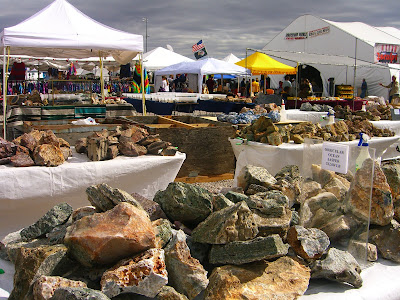
Tucson, Arizona is known for a lot of things, but every third week of January until the second week of February, it plays host to the “Greatest Show on Earth” in the mineral world (Wilson 2004). This is the annual Tucson Gem, Mineral, and Fossil Showcase, going on its 55th year. Popularly known as the Gem and Mineral Show, the Tucson Show, or simply “The Show,” the Tucson Gem, Mineral, and Fossil Showcase has all the elements of commerce, earth sciences, paleontology, archaeology, technology, art, curating, culture, and crafts. Many of the world’s top private collections and public museums have exhibited here. The fellowship, networking and learning experiences generate so much social and cultural energy amidst the high desert scenery of Tucson. To Bob Jones who has attended it more than 40 times and who wrote about its 50 year history in 2004; “it is the “single most important gem and mineral event in the world.”


The Tucson Show is simultaneously a show, museum tour, exhibition, market, bazaar, swap meet, convention, conference, workshop, party, fiesta, pow-wow, food-fest, and tourist destination that brings together over 50,000 unique visitors, collectors, curators, dealers, buyers, scholars, enthusiasts, tourists, students, artists, even hippies to this three-week event. In 1969, then curator Paul Desautels of the Smithsonian Institution and one of the most active supporters of the Tucson Gem and Mineral Show called it “The New York Stock Exchange of the (mineral) world”. Bob Jones quoted him saying “the price of mineral specimens for the world is more or less set at this show.”


If you want to see the latest mineral find, some of the most exquisite gems, or newly unearth mammoths, the Tucson Show is where you should be. Do fossilized dinosaur molars or coprolite (dung) pique your interest? How about petrified wood? Have you seen a meteorite weighing more than 600 kgs.? How much exotic seashells and corals are from the Philippines? Do you want to know and see what ammonites, crinoids, or trilobites are? There is no other showcase like the Tucson Show and it is something an enthusiast should experience even once.


The recent 2007 Tucson Show had 5,079 exhibitors in 49 individual shows, the most ever not counting the unofficial ones. This year the numbers dipped because of the U.S. recession and the housing meltdown that hit Arizona hard. Nevertheless, these shows were scattered all over the city in banquet halls, foyers, and bedrooms/ suites of hotels, convention centers, parking lots, warehouses, or any available space, security permitting. Most shows are open to the public. An economic impact survey-assessment of the Tucson Show by FMR Associates (2007) estimated total gate attendance at 362,816 buyers, each of whom attended an average 6.6 shows. They estimated unique persons attendance at 55,056, the highest ever and 59% more than the 2000 estimated figure of 34,618 persons. Exhibitors came from 42 states of the United States and 38 countries, while buyers came from 43 different states and 24 different countries. If you want to see globalization localized, the Tucson Show will make for a good study.

Economic Impact

The FMR study (2007) noted that the Tucson Show is an economic juggernaut conservatively contributing over $100 million in direct expenditures to the local economy, up from $76.4 million in 2000. Lodging, food/beverage and in-town transportation expenditures alone amounted to $49,549,718. The estimated tax revenue from the show was $9,057,217 in local taxes paid on $90,206,326 of taxable expenditures. This is an increase of 51.2% from the year 2000 figures. In terms of likelihood of return to Tucson, majority of the majority of exhibitors (63%) and out-of-town buyers (78%) indicated that they will return and/or attend the 2008 Tucson Gem Show. These figures do not include the sales and trades made during the three week period. Further, as many of these sales are wholesale, the multiplier effect of retail sales as well as conversion into artistic pieces or jewelry for sale worldwide are not accounted in this study.

The Tucson Gem and Mineral Society itself has long been active in community affairs, which also helps the local economy and education sector. Proceeds from the Show have assisted the Arizona State Museum, University of Arizona Mineral Museum, the Southern Arizona Regional Science Fair, the Southern Arizona Rescue Association, the American Federation Scholarship Fund, the Tucson Special Olympics, the Arizona Boys’ and Girls’ Clubs, the Arthur I. Flagg Memorial Foundation, the Smithsonian Institution, Mineralogical Record magazine and Rocks and Minerals magazine. Significant amounts of money have funded scholarships to the Advanced Studies Earth Science Programs at the University of Arizona according to Bob Jones.

Tucson show in Manila!


From Downright with Ammonites

For the last five years, we’ve been fortunate enough to host our godparents who are avid collectors of fossils, petrified wood, and minerals. This couple, Larry and Pat Gotuaco, of San Francisco and Manila, are well-known and highly regarded in the seashells, Chinese blue and white ceramics, and now minerals and fossils collecting worlds. Tito Larry along with Rita Tan and Allison I. Diem are the authors of the much sought after coffee table book, Chinese and Vietnamese Blue and White Wares Found in the Philippines (1997). After assembling a fantastic collection of seashells and Chinese ceramic, he has now focused his attention on the what he calls “God’s Art.” Afterall, he says, “in Chinese blue and white ceramics you can endlessly debate on the age of a ceramic piece, which is of a time period of a few decades to a few hundred years, but in fossils and petrified wood, we’re talking tens to hundreds of millions of years ago.”


Exquisite ammolite up close from Downright with Ammonites"

What really caught the eye of the Gotuacos on their worldwide search and collection of fossils, minerals, and petrified wood is the natural color and beauty of these specimens. No artist, living or dead, can surpass the color combination, structure, and composition of each piece, whether it is a mammoth’s tusk, fossilized dinosaur dung, or the most colorful Arizona petrified wood. Indeed there is beauty in nature that is simply breath taking. Even the processes of fossilization and petrification, wherein organic matter such as bones, felled trees, or even dinosaur dung get buried in sediment for millions of years, with their organic material eventually being replaced by minerals and silica/minerals respectively, are short of awe inspiring.

These specimens though give you another surprise. Get a camera and take a “macro” or close up shot of a small part of the piece and you see the complexity of colors and structure. It is even more beautiful and majestic.

Words, however, will never be able to describe the fiesta atmosphere of the Tucson Gem, Mineral, and Fossil Show. Worse, words do not let you see and feel what these tens of millions of years-old specimens are.

The Gotuacos though are a very generous couple. They are also stalwarts of experiential learning. Since they started collecting, they’ve always dreamed of bringing the Tucson Show to Manila. They saw the value of an exhibit engendering interest in geology, paleontology, archaeology, astronomy (yes, meteors!), and the natural sciences. Filipinos need and deserve these kinds of learning experiences. Thus, despite, initial setbacks, they managed to convince Ayala Museum to exhibit part of their collection.

Images In Stone

Entitled IMAGES IN STONE: Art in Fossils from the Larry Gotuaco Collection, the exhibit opened on 16 September 2008 at the Third Floor Glass Lane, Ayala Museum and will run until November 30. Workshops are being scheduled for macro photographers and even a kids session on collecting this coming September 27. This is a precursor to the book he is writing on petrified wood.

This is one exhibit the family should not miss.

Give yourself an hour or two for the exhibit. Better yet, give yourself half a day to explore the other exhibits and collections at the new Ayala Museum. The Crossroads of Civilization is a must see. For the politically inclined there is the I am Ninoy exhibit.

Bring the family, learn something new, and learn more about your country.

Wednesday, September 10, 2008

Country First! But, whose country and who first?

The Republican National Convention (RNC) held last week did not fail to intrigue and pique the interest of Americans and the worldwide audience. They certainly did catch our attention. After the resounding debut of Barack Obama and Joe Biden at the Democratic National Convention (DNC), the RNC scuttled their first day because of Hurricane Gustav. The announcement of Alaska Governor Sarah Palin as the vice-presidential nominee the Friday before carried them through though. Gov. Palin was a new and pretty face, a hockey mom, feisty, and charming. Pending further vetting of her, she is a fresh face for the Republicans beset by the chaos in Iraq and Afghanistan, the lingering tragedy of Hurricane Katrina, the housing implosion, the economic recession and accompanying “mental depression”, and the health crisis. Republicans, observed the New York Times’ columnist David Brooks, entered the RNC practically morose.


The Republicans, like the Democrats, promised change and reform. This they hope to accomplish via three primary strategies.

The first is a change of Republican and, hopefully, national leadership anchored on the man once called the “most trusted man in America” and now a “maverick,” Arizona Sen. John McCain. He will be backstopped by the charming, full of energy, and emerging symbol of the Republican woman, Gov. Sarah Palin.

The second is that, with a focus on the track record and character of both candidates, they will reform Washington and overhaul how politics is practiced.

The third is a renewed emphasis on patriotism and increased security. It is about confronting perceived American enemies anywhere in the world to ensure the country’s security from terrorism. In other words, the “war on terror” will continue.

If the objective of the RNC was to re-energize and rally its base (of supporters), this they accomplished. Sen. McCain attracts the security-conscious voter, while Gov. Palin brings to the table interest, intrigue, and an appeal to the woman vote. What we will see is a United States that will vote on the fault lines of race, gender, class, and socio-economic issues.

In deconstructing the Republican message and their policies based on the speeches over several days, the elements were similar. My comments and that of others follow below.

The focus on the biography and heroism of McCain was smart, because it detracts from the failings of the Bush administration of the last eight years. The goal was to put enough distance between him and the Bush administration. To further emphasize this gulf, they pulled a surprise in presenting a VP candidate out from literally nowhere, Wasilla, Alaska that is. It was a risky move characteristic of McCain the maverick.

After this spectacle of surprises, what comes next? Their message was that character and a track record of heroism is needed to reform Washington. I find this hard to believe, since the base of supporters and funders of the Republicans espouse policies that will ultimately and literally, fry all of us.

Rudy Giuliani’s “Drill baby drill”, his roguish laughter, and his cheerleading of the RNC participants as they repeated the chant were chilling. He, other speakers, Gov. Palin, and finally, Sen. McCain followed this up with a commitment to re-start the nuclear power program. They actually believe that the road to energy independence includes drilling for more oil and nuclear power.

I foresee global warming and a mushroom cloud.

Drilling for oil in the U.S. is full of myths and disinformation. See “Four offshore-drilling myths” by Eoin O’Carroll. Basically, there isn’t much oil left and what’s left is too deep and expensive to drill. Oil is a finite resource. In finance, oil is the equivalent to capital . You shouldn’t be using up the capital, just the interest. Where is energy and fuel conservation? Raising vehicle fuel standards? Where is government, in Thomas Friedman’s words, in reshaping the market to encourage renewable energy and alternative fuels?

The issue with nuclear power is nuclear wastes have a lifetime of thousands of years. Except for the Church, no institution has survived thousands of years to manage these nuclear wastes. Who would be reckless enough to leave to future generations the responsibility of taking care of wastes that can cause the extinction of the human species? All that for the privilege of consuming more, making the nuclear power industry rich, and avoiding conservation measures? Lastly, there are embedded risks in nuclear energy because of its complexity and life cycle (from mining to processing, use, and waste disposal) that have been expertly dissected in Charles Perrow’s classic Normal Accidents .

In a RNC dubbed “Country First” with an emphasis on veterans, McCain’s heroic war record,and patriotism, fighting was the code word. McCain himself used the word “fight” at least 25 times in his acceptance speech. Either his statements will vault him to the presidency or condemn him as the proponent of a culture of death and conflict. As he said; “Fight with me…Fight for what’s right for our country…Fight for the ideals and character of a free people…Fight for our children’s future….Fight for justice and opportunity for all…Stand up, stand up, stand up, and fight.”

Apparently, the police and authorities took his exhortation to fight literally. While there were anarchists who caused trouble, police brutality against varied protest groups were extensively documented. At least 400 were arrested for the flimsiest of reasons, journalists hurt, and scores of protesters maced and clubbed. The mainstream media hardly covered it, but the gory details can be found on-line. See Vital Source for a round up on the violence during the RNC. Photographers documented and wrote about police abuses. Journalist Amy Goodman, herself arrested and manhandled, recorded the Ramsey County Sheriff using infiltrators in the protest marches.

The last is on security and the never-ending “war on terrorism.” Despite the debacle in Iraq and Afghanistan with hundreds of thousands dead, including innocent civilians, thousands of dead and wounded American soldiers, a monthly $10 billion bill, what has the United States accomplished? Two failed states and millions of angry relatives of the dead and tortured. An American economy that is being bled dry because of military over-reach. The question still remains, who is the terrorist? If the terrorist is STATELESS, why engage in a conventional war?

This “war on terrorism” has proven profitable for those engaged in what former President Ike Eisenhower called the military-industrial complex. Only a few companies actually benefit, with the nation taking on a terrible burden. Growing the economy through endless conflicts doesn’t seem like good business sense.

Lastly, are Americans really being threatened by other nations? Iran, North Korea, Venezuela are touted as rising threats. This shows little faith in diplomacy and the American military. Did you know, the United States has 761 military bases across the planet? Really, is there a country willing to take on the vast American imperial military? If terrorism is a problem, use counter-intelligence, diplomacy, and police work. Development, not warfare, is the best strategy of “draining the swamp” of terrorism.

My observation is that all candidates have the character, integrity, and dedication to lead the nation. What separate the chaff from the grain are the policies.

Who presents a vision of the future of investments in renewable energy, education for all, affordable health care, safety nets for the poor, rebuilding of the economy, and those espousing sharing, caring, peace, and a concern for the environment? Who presents a vision of the USA as a moral leader, quoting Bill Clinton again, leveraging “…the power of our example than by the example of our power?”

The American people will be voting for their future this coming November. What kind of change will it be? Will it be one based on hope and values or one based on more of the same?

For Fil-Ams, they need to seriously reflect on who they support. Like the DNC, they were invisible. Worse the RNC was a pale affair. How can RNC hope to reform and change the course of this complex country with only one race? See Washington Post’s article on the lack of diversity in the RNC.

Many Fil-Ams or their parents fled the Philippines mainly because of the lack of economic opportunities. They need to support candidates who are sympathetic to economic migrants. Importantly, they need to support candidates who work for the reduction of income inequality, strengthening of the middle class, and engage minorities. To support candidates that DO NOT support these initiatives, Fil-Am voters only become like the politicians and caciques that they escaped from.

The future is in your hands.