Saturday, May 10, 2008

Pangea Day was awesome!

These are the hands, what are you going to build with them?
- a line in the song sung by Dave Stewart, Co-Founder, Eurythmics at the Pangea Day celebration

Pangea Day ended about 50 minutes ago. Yet the sights, sounds, and the messages linger on. Pangea Day was a powerful four hour global performance. It showed how the power of convergence on a global scale of film, art, music, dance, information and communication technologies (ICT). In other words, CREATIVITY in the different disciplines and activities of humanity can promote peace, forgiveness, social justice, remembrance, and most importantly LOVE for our fellow human being.

This was an experiment in promoting peace- through social memory, of combatants in the Middle East getting together, opening their hearts, and talking to one another, in the hopes of forgiving one another. As one victim asked, "If we who have lost the most precious in our lives can forgive, why can't others and our leaders?" (or words to that effect).

-through laughter as an Indian guru suggested and performed...

- through remembering the past and working at a better future...

-through music, singing another people's national anthem...

-through sports, by playing volleyball using a border wall as the net..

- through the lived experience of oneself or of others...

My dissertation research on Gawad Kalinga has opened my eyes (and heart) to the powerful force of love, servant leadership, caring and sharing. It also made me aware that much can be achieved through the CONVERGENCE of CREATIVITY and of CREATIVE, LOVING PEOPLE.

Look into yourself and those around you.

Become more aware of the creativity to do good in yourself and the good being done by others.

One speaker noted that "we are the same species, with the same problems, living in one planet..one day there may not anymore be the OTHER..."

One world, one heartbeat.

Check out Karen Armstrong's inspirational speech at Pangea Day.

Pangea Day is on now!


Pangea Day is on!


They've started show the films.

The current film is about refugees and war in Africa.

Check out http://www.pangeaday.org.

Anthropologist Donald Brown is now speaking about the "human universals of language", which include the spoken and written word, gestures, facial expressions, social memory, etc.

24 films, 4 hours, 180 countries simultaenously showing the films...Bringing the world through film...

Thursday, May 08, 2008

Pangea Day


Pangea Day

Pangea Day is this coming Saturday, 10 May 2008 at 18:00 GMT. The 24 films chosen out of more than 2,500 entries from over 100 countries will start broadcasting in the Philippines at 2:00 a.m. In Tucson, Arizona, the showing starts at 11:00 a.m.

Pangea is the brainchild of noted filmmaker Jehane Noujaim who won the TED Prize (annual Technology, Environment, and Design conference) in 2006. The annual TED Prize is worth $100,000 and a ‘wish’ that TED organizers assist in fulfilling. Ms. Noujaim’s ‘wish’ was for the whole world to get together through film.

Her 2006 wish is now about to become a reality.

Her vision inspired so many groups, organizations, corporations, and individuals. In over 180 countries, there will be Pangea Day gatherings and showings. What’s notable about Pangea Day?

Pangea Day and the films underscores the transformative power of:

  • Creativity- film, music, the written and spoken word
  • The beauty of Earth
  • Love, friendship, peace
  • The struggle over the evil, injustice, and violence in the world
  • The enduring notion and reality of community, from local to global to local and the power of ONE global family
  • Culture, acceptance and embracement of diversity and our own uniqueness as individuals and as a member of a community
  • Wisdom and knowledge and learning
  • Convergence of science, spirit, and art, as well as people, talent, time, and resources

Pangea comes from two Greek words: Pan meaning entire and Gaia, meaning earth. Pangea is the hypothesis that the all the continents once constituted a single supercontinent about 250 million years ago. German astronomist and meteorologist Alfred L. Wegener first proposed (1912) this continental drift theory and suggested the term Pangea.

The metaphor of an original wholeness now separated, but whose configurations complement each other is a powerful one for humanity.

Watch the film. Get inspired. Love deeply and ACT (excuse the pun)!


Wednesday, May 07, 2008

ONE, a celebration of Gawad Kalinga in San Diego, May 24, 2008

Poster and text below from:
http://www.gk777sd.com/

ONE is on! The unique Filipino celebration will introduce itself on Saturday May 24, 2008, at Kimball Park, National City.

ONE is a movement standing for solidarity among Filipinos in America, where diversity is acknowledged, appreciated and invited to find unity in common causes seeking the serve the highest interests of Filipino-Americans. Beyond that, ONE also seeks to actively facilitate the fruition of Fil-Am dreams to build a homeland of their dreams. In pursuit of this, ONE links with Gawad Kalinga, the fast-growing nation-building movement that focuses on dismantling a shameful poverty in the homeland that is a blight to all Filipinos wherever they are in this world.

ONE will be from 10 am to 6 pm at Kimball Park, home to major Filipino events in the county. It will be a full day of festivities where the best of the Filipino will be showcased and harnessed to propel a great initiative for solidarity and honor. The day begins with two grand events - a caravan of heroes helping the homeland through Gawad Kalinga which will begin from several points from LA to Las Vegas, and a fun ride organized by the Sikad ng Bayan and joined by other cycling groups. These will converge through the Filipino - American Highway in National City.

ONE then shifts to Kimball Park where different Fil-Am organizations representing all the different provinces will converge. It will be a day of fun, food, music, dance and fellowship where even children will be catered to. Kimball Park will be a landscape of colors that reflect the tropical ambiance of home.

ONE is born!

Let us be ONE People and ONE Unified Nation once and for all.

Friday, April 18, 2008

Lessons from Peru's former President, Dr. Alejandro Toledo and Gawad Kalinga

Today, I attended a symposium entitled: Social Justice in Health: Local to Global at the University of Arizona.

I also presented a paper on Gawad Kalinga entitled Save the Poor Save the Environment, Save the Environment Save the Poor: The Gawad Kalinga Social Movement on Community Development. This is my third presentation on GK in the past three weeks.

In the symposium, the keynote speaker was former Peruvian President Alejandro Toledo who led Peru from 2001-2006 and was very successful in reducing poverty, inequality, and exclusion (PIE) through various creative and commonsensical means. Peru's social and economic indicators speak for Alejandro's success.

I liked his talk. First, he calls himself an "accident" in that meeting two Peace Corps volunteers eventually led to him, a sheep herder and shoeshine boy, studying at the U. of San Francisco, eventually earning a PhD in Stanford, teaching in Harvard and Stanford, working at World Bank and other top agencies, and culminating with becoming Peru's most effective president. He said that his "accident" should be normalized for all Peruvians and Latin Americans.

The other point is that his effectiveness at governing lay not really in his academic credentials (an understatement), but rather in his inexperience in politics. Not being a professional politician enabled him to reduce military spending by 23% to the shock of his generals and reallocate the funds to social services, including education. He was also able to forge a fair and free (not lopsided) trade deal with the U.S. and expand trade deals with the E.U., China, and India. Hence, Peru's outstanding economic growth and poverty reduction numbers.

He emphasized to the American audience that political INexperience is NOT a barrier to effective governance. We had a laugh at his "meddling" in U.S. elections.

During the open forum someone asked him about the need for family planning in Peru. His answer was full of wisdom. Dr. Toledo said that family planning should be taken in its whole context. It is not simply about providing contraceptives. Rather it involves providing the information in a socially acceptable manner. It is about education. It is about health and nutrition. It is about improving the household situation. It is about poverty reduction. It is about choice and freedom. But choice and freedom is made and attained respectively only when a person or the family is healthy, has access to affordable nutritious food, is not poor, educated, and is earning a decent living. He added that higher income societies usually have smaller families. Thus, family planning is best implemented within a context of total human development.

What does all of the above have to do with Gawad Kalinga and Harvey Keh?

First, Dr. Toledo, Barack Obama, the highly successful "Life is Good" clothing chain or even charismatic movements share one thing in common, the message of HOPE. Excluding the charismatic movements, the first three emphasize that the power of HOPE, combined with positive energy, creativity, and hard work will lead to success. If it works in business and in politics, why not in social change?

HOPE is the key word in a world full of elections in the next two years. I think the Hope message resonates well with voters. HOPE will probably get you elected, but it is certainly needed in CHANGE.

Second, social movements work best when they don't let organizing get in the way of mobilizing. Both go together, but one should not be at the expense of the other. Harvey Keh calls for greater vigilance against graft and corruption. Yet, he doesn't show us how and defaults to values transformation, which, incidentally, is a core initiative of GK. He calls for more honest officials. We're all calling for that, but the real question is how do we get from here to there? Keh's irony or bureaucratic "iron cage" is that he heads two organizations, and is a ranking officer of a third. As some have noted, what is an organization if it cannot mobilize and deliver SOCIAL CHANGE?

The current state of Philippine "opposition" politics is that they fail to appreciate the transformational value of GK . In failing to do so, they miss out on the opportunity to provide transformational and charismatic leadership.

Dr. Toledo said that democracy is useless if there is no SOCIAL and ECONOMIC democracy. Democracy works best if the PIE is reduced, PIE being poverty, inequality and (social) exclusion. Democracy is strengthened when the citizens are engaged. They are engaged when they have a roof over their heads, when they have access to healthcare and nutritious food, when they are earning a living, and when they are educated. Democracy is multidimensional.

Pre-colonial societies in what is now the Philippines were ruled by datus or chieftains who attained their status in two combined ways namely, leadership and bravery in conflict and leadership, intelligence, and creativity in engendering a peaceful and prosperous community. It was not an either-or, but an AND of: physical security and economic well-being.

Thus, any group that seeks to challenge the incumbent administration, rightly or wrongly, needs to present to the Filipino people their roadmap for political, economic, and social democracy.

If one wants to tear down the house that is the Philippines to drive away an "unwanted guest", please make sure that the house to be re-built can withstand 265 kph winds, has running water and flush toilets, has a beautiful garden, and is near schools, health centers, and places of work. Please also make sure that meaningful work is available and that the neighborhood is peaceful...

In reality, no one, no organization, no institution has presented a model of social change that is comprehensive, holistic, scalable, replicable, self-sustaining and importantly ADAPTABLE to different contexts than what GK has proposed and is proving with each passing day.

Dr. Toledo's Peru has shown what an inspired, positive, and creative political leadership can achieve. His is a model of leadership at the pinnacle of POWER. Filipino politicians would do well to probably follow in Dr. Toledo's foot steps if they think they are up to the task.

GK, on the other hand, provides for servant leadership from the ground up. It is a bottoms up approach to development in the near absence of effective governance. Dr. Toledo's wish and aim is for the likes of him, an "accident of history", becoming the norm.

GK is showing how future Dr. Toledos will be formed. It would do well for Dr. Toledo to consult with GK.

Lastly, the brouhaha over the alleged Vatican displeasure of GK's "overemphasis" on social work is belied by the annual solicitation letter I get from the Bishop of the Diocese of Tucson for the numerous social works they are engaged in the diocese. The list is long, the beneficiaries numerous, the goals ambitious.

Is the Bishop overextending himself?

Should I report him to the Vatican?

For groups such as Couples for Christ or even the Roman Catholic Church to retain membership they need to increase their social works. Afterall, that is what AGAPE is really all about, loving the most vulnerable in society as Jesus did. CFC then is on the right track with its Gawad Kalinga ministry.

While Arizona may be in a unique situation because of the xenophobic immigration issues and the sexual abuses scandals of the clergy, I have noticed the increased activism, social justice, and social works initiatives of the Catholic Church here.

There are unmistakable 'signs of the times" especially in the field of social change. GK has read these signs well and acted on it. Massive mobilization of volunteers, talent, and resources. Sharing and caring. Servant, heroic leadership. Looking into ourselves and recognizing our greatest assets. Treating the poor as partners in development. Tapping cultural traits of padugo, bayani, bayanihan, bayan. Claiming the true definition of faith and patriotism. Discerning the yearnings of the Filipino diaspora for a progressive Philippines. Channeling the "legacy" angst of the elite into nation-building. Harnessing peace as a productive force. Making 'convergence" work effectively. Melding the "science and spirit" of community development. Showing the effectiveness of adaptive management. Finally, laying the groundwork for what the late Fr. Horacio dela Costa said about "recapturing the bureaucracy."

GK stalwarts Boy Montelibano and Tony Meloto said that GK will appeal to certain people and that all GK needs to do is "build it and they will come."

I agree. I believe that revolutionary/ disruptive social change is really through culture work that is creative, positive, optimistic, and charismatic. GK best exemplifies this.


Tuesday, April 08, 2008

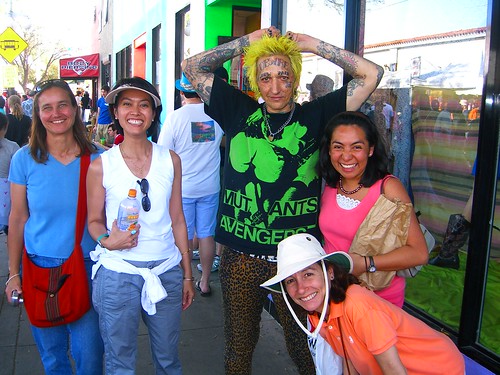
Beauties and the...cool dude


Beauties and the...cool due, originally uploaded by livingplanet.

Fellow was nice enough to stop and have his picture taken. He placed his arms around the ladies, but they said, "Hey show the tattoos in your arms!"


4th Ave. is a pride of Tucson. Nice colorful homes turned into shops and restaurants. Lots of environmental initiatives launched here. Native SEARCH, the biking community, hydroponic, and other eco-shops mingle with artisan, artsy, bars, and coffee shops. Lots of creativity and innovation here.

4th Ave. denizens: Dangerous blonde and men in kilts

Two of, if not the biggest events in Tucson, Arizona in terms of visitors, are the 4th Ave. Fall and Spring Fairs, which bring out the Tucson community. Families, merchants, artists, denizens, hippies, musicians, and all sorts of folks gather to eat, drink, trade, sell, buy, and enjoy the sights and sounds of the 4th Ave. Fairs. They enjoy the over 400 booths hawking everything, dozens of food and drink booths, children's games including two climbing walls and rides, and street musicians, artists, and fortune tellers. It's quite an experience.


My memorable sights include this beauty with her pet snake.


Men in kilts


Sunday, April 06, 2008

Padyak

From Padyak.org

The UP Padyak Project

- a bicycling project for the University of the Philippines Diliman Campus, which aims to make a concrete contribution to the University on its Centennial celebration. Initiated by members and alumni of the UP Mountaineers in response to the imminent threat of global warming among many variants of the environmental crisis. This project aims to promote bicycling as means of transportation and lessen dependence on fossil fuel vehicles. It also aims to promote health and fitness in the campus community.

Students will be renting the bicycles at very affordable rates, which will cover rent of an easy-rider bicycle, training, access to bicycle racks and cable locks per semester.

The dry run of the project will start on April 11, 2008 (Summer 2008) through the help of volunteer bikers. Full implementation of the project is planned for June SY 2008-2009.

These brightly-painted bicycles with step-through frames are designed not for speed but for comfort, safety, visibility and function. Utility baskets will be mounted on the handlebars where students can place their belongings.

The UP Padyak Project is privately funded by the members, alumni and friends of the UP Mountaineers.

Of Bike Racks and Trashcans: The 4th Ave. Spring Fair 2008 April 6

One of America's top street fairs is held every Fall and Spring along six blocks of 4th Ave. in Tucson, Arizona. Named after 4th Ave. where the fairs are held and now on its 38th year, the 4th Ave. Fall and Spring Fairs attract 200,000-400,000 visitors. Over 400 arts, crafts, and clothing booths, dozens of food and drink vendors, street musicians and street performers, political activists, hippies, artists, and all sorts of people join the merchants, stores, and restaurants along the hip, hippie, and artsy 4th Ave. The three-day celebration is an expected and fun-filled gathering of the Tucson community and out-of-towners.


The 4th Ave. Spring Fair was held this weekend (April 4-6) and had some great finds in terms of art, jewelry, crafts, and collectibles. Two wall climbing towers were set up along with a “VAN GROW” kids hands-on-art area. Dozens of food booths served an international menu ranging from Mexican, Thai, Greek, Italian, among others to regional fry bed, tri-tip BBQ, fried chicken and more.

4th Ave. is also known as a bastion of the biking community in Tucson. Bike swaps are held regularly with the next one coming up on April 20. The last swap attracted 15,000 participants. On both sidewalks of 4th Ave. are bike racks and trashbins made out of old bike parts. Many look eclectic and funky and add to the artistic and iconoclastic atmosphere in 4th Ave. Check out my photos below.

Friday, April 04, 2008

Martin Luther King's 40th

I attended the annual Society for Applied Anthropology (SFAA) recently in Memphis, Tennessee. It was a good and relevant time, considering it was the 40th death anniversary of Dr. Martin Luther King.

Being a starving graduate student, I booked my hotel far from the conference hotel and took the bus everyday. I considered renting a car, but being the nosy anthropologist, what better way to explore Memphis than by public transport and walking.

The bus I took passed through the deteriorating parts of the city as well as those struggling to renew itself. I saw many boarded up homes and buildings, walls with graffiti, and homeless people. It was dreary and depressing.

On the way back to the hotel, I would take the night loop. At first it was scary, as the passengers were predominantly of one color. A few were a bit aggressive in their panhandling. But after a few minutes, I couldn't stop myself from eavesdropping on the conversations of the passengers. I even had a hard time from laughing at the jokes of this group of FedEX workers as they ribbed each other. They really enjoyed their "schoolbus" ride home.

I had fun talking to the bus drivers and my very knowledgeable cab driver, Mr. Turner. Ordinary folks were helpful and friendly in their own way. Good luck Memphis!

Monday, March 31, 2008

Gawad Kalinga at the University of Arizona

Last 4 March 2008, Dylan and Anna Wilk along with their two babies, Nathan Mari, and their cousin visited the University of Arizona and talked about Gawad Kalinga and the Highway of Hope caravan. They are on a 65-city speaking tour which will culminate in San Diego on Memorial Day weekend. Their speaking tour seeks to generate awareness on Gawad Kalinga as well as to recruit volunteers to the GK One Million Bayani (Heroes) volunteers or GK1MB program.

At short notice, close to 30 persons attended including the heads/ officers of the Filipino-American Sampaguita Club of Tucson (FASCOT), the Filipino-American Students of the University of Arizona (FASA), the U. of Arizona multicultural office, the U. of Arizona international students office, the Diocese of Tucson, students, and residents of Tucson.

Dylan eventually wrote about his trip to Tucson and his hope for a GK Arizona village with saguaro cacti, boots, and spurs as village symbols. We hope so!

Check out the videos below.


Dylan's story of how he learned about GK.


How you can help...


Nathan Mari, GK1MB Coordinator


Nathan's clothes and enlightenment...


Fr. Miguel Mariano, Diocese of Tucson responds...

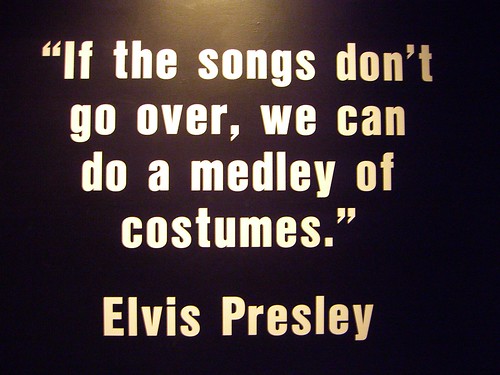
the costumes


the costumes, originally uploaded by livingplanet.

I was in Memphis for the whole week attending the annual Society for Applied Anthropologists (SFAAs). No first time visit to Memphis is possible without visiting rock n roll's greatest singer's mansion, grave, and exhibits. Elvis Aaron Presley parlayed his good looks, great singing, cool demeanor, sexy dance steps, and charming personality to a cultural and commercial revolution.

His costumes were not only fashion statements but cultural statements as well, copied by other rock stars. His interests were varied. He was a good marksman, loved martial arts, was into luxury and sports cars, and liked his Harleys, golf carts, and powered up motorized toys.

He was generous to a fault and loved to party. He was appreciative of the audience and really cared for them, worrying if he still had an impact. Many say he was courteous, likable, and considerate.

He may have had many faults, but no one can fault him for his music, his dance, and that uniquely cool demeanor only an Elvis Presley can summon up.

You rock Elvis.

From a fellow twin....

p.s.

the Flickr photos were taken without flash, since the exhibit banned flash photography....

Pinoy Polka, the Papaya Dance

What do you get when Filipinos invent a new dance craze called Papaya, danced to the song of Polish phenomenon Urszula Dudziak? Pinoy Polka!

They get everyone, from the U.S. Ambassador Kristie Kenney (very charming and good looking!), to dance...


The Philippine Army got into it..


It's being covered by the worldwide media now...


Recently, ABC's Good Morning America talked and danced about it...

Check out the response in Poland...

Wednesday, March 19, 2008

Virtual Power: The Brian Gorrell Saga

Brian Gorrell picture taken by himself

Power is of different forms. The most obvious is the coercive one based on the threat of violence or the use of money to be able to threaten reprisals. However, there are five other forms of power including: (1) the power to reward for complying a.k.a incentive, (2) the power of legitimacy, which enables one to make a request or order, (3) the power of expertise or knowledge that enables one to get something done especially during a crisis situation, (4) "referent" power, which attracts would-be followers to a perceived leader, and lastly, (5) informational power, which is unique and desired information that is held by someone (French and Raven 1959, Raven 1965, Yukl and Falbe 1991).


In countries of high inequality such as the Philippines, the elite control these varied forms of power stemming from early access to material resources such as land and other natural resources and the largesse from holding public office for generations. Today, the elite, organized around family and extended through clans that share the same thinking and culture are in business, in politics, and control the flow of information, the means of communication, and the construction of social and political meaning. This hegemonic power may look impregnable, but as they say social theory must conform to social reality (Balicasan and Hill 2003).


And the reality is that the powerless may not really be powerless at all. They have options, they have agency, meaning they can think, reflect on their situation, and act. Banding together or accessing resources or groups willing to help can provide them with even more latitude to change their situation and gain more independence from the powerful. It is a struggle, maybe even a long and painful one, but the powerless can enter the realm of the possible. A political scientist and ethnographer, James C. Scott wrote a book entitled Weapons of the Weak: Everyday Forms of Peasant Resistance. In the book, he documents the relations between the rich and powerful and the poor and seemingly powerless peasants in a Malaysian town. He notes how the rich continually seek to control and manipulate the poor, including trying to escape from their moral and economic obligations to the latter. It reminds me of the 1991 work of Benedict J. Tria Kerkvliet, entitled Everyday Politics in the Philippine. Both authors illustrate how the poor resist and struggle for equality with tactics ranging from appeals, negotiation, protest, sabotage, or even violence. Some of these may be open, but often secretive, "furtive, and below the surface" (Yee 1992). It is a two way street, this contesting relationship of rich and poor; it is busy, in flux, and dynamic.


Keep this in mind as you look at what's happening on-line vis-à-vis the Philippines' powerful. Marshalling the millions to demand the ouster of President ERAP Estrada in 2001 was mostly done digitally through text messaging. Last year, a society columnist wrote about her unease flying and interacting with OFWs in the cities she visited. Unfortunately for her, she forgot there are now more than 8 million Filipinos abroad, working hard, earning decently, growing and learning from travel, exposure to other cultures, and ways of doing things. Because of personal growth and more earning power, they are becoming more assertive. And they are online.


Thus, immediately, Filipino bloggers and OFWs worldwide bombarded her and her newspaper with scorching remarks, which led to the newspaper suspending her. Today she is more circumspect in her comments. Unfortunately, again for her, her tacky remarks will exist forever online. The virtual storm that Teri Hatcher's line in Desperate Housewives generated forced ABC officers to apologize and commit to be more sensitive and proactive on Filipino-American issues.


The attempted power grab by Senator Trillanes and General Lim in November 2007 was followed on-line and supported by a website posting information on their political platform. The NBN-ZTE scandal and other charges of corruption by officials and family members of the GMA administration were exposed online and morphed from reporting to commentary and even YouTube videos. Not only are these effective, these forms of “information” are also embarrassing to the personalities involved. Their effectiveness will only and eventually be undermined if opportunistic politicians with no credibility, vested interests, and incompetent civil society folks usurp the movement for accountability.


The latest online spectacle is the Brian Gorrell saga wherein a socialite member of the infamous Gucci Gang of Manila allegedly swindled this Australian of his life savings of $70,000 during and after their stormy love affair. With no recourse to Philippine justice, having been harassed, and receiving death threats, he writes that he needed to fight back. Afterall, he is HIV positive and needs the money for his treatments and to rebuild his life in Australia and Canada. While he initially thought he was powerless, he isn’t. He has informational power- inside information on the goings on of Manila’s, rhetorically and literally, high society. He claims to have and writes about his first hand knowledge of the sex, drugs, alcohol, shenanigans, and dirty secrets of the Gucci Gang and their party mates.


Through strip-tease blogging, he captured the attention and imagination, not only of Filipinos worldwide, but the worldwide online audience as well. His informational power is now possibly becoming referent power and legitimate. His blog has also led to unintended consequences. The blogging format enables anonymous readers to pile in more “dirty” information about those in power. What was in the pre-blogging era a blind item in newspaper columns (neither subject nor news source were identified), are now openly detailed by unidentifiable sources; in essence, virtual and multiple "Deep Throats."


Thus, you can spend hours reading through Gorrell's blog's comments section on a Senator allegedly using taxpayers money for his entourage’s shopping in Europe, society newspaper columnists who actually don’t write their columns, drugged out celebrity endorsers, secret homosexuals and lesbians, despicable treatment of household help, socialites on the verge of bankruptcy, who stole what, sex and drug orgies, and so on.


How this will continue will be hard to tell. Both sides are not passive. The Gucci Gang and those that have something to hide and their names to protect are allegedly mobilizing to either settle with Gorrell or shut him down. It may be quite difficult now that he is out of the country and his ex-lover who is in the center of all this is incommunicado.


Gorrell’s blog, on the other hand, is another venue where middle class Filipinos, OFWs and others disgusted with the crassness of this group and what they represent politically, economically, and socially, can and do show their contempt and anger. They are supporting him even to the point of offering him monetary support.


The conflict is good in my opinion. It shows the best and worst of the Filipino, which is social reality. It shakes up Manila society and may force the producers of meaning- the mass media, celebrity endorsers, businessmen, and even the public to reflect on what they are doing and consuming. Does the Gucci Gang reflect what urban Filipinos are all about (since most of them are product endorsers, event organizers, and society columnists)? How do we want to promote tourism and recreation, including nightlife, in the Philippines? What, paraphrasing Lozada’s term, is the permissible zone of indiscretion that we allow the rich and powerful? What are the obligations of the rich and powerful to individuals and to society?


There is conflict, seething conflict, albeit under the surface, between the classes and sectors of Philippine society. Inequality is significant and the benefits of economic progress are skewed to a minority elite class. This cannot go on forever. These online sagas reflect these conflicts. The powerful should heed the signs of the times.


Lastly, I am a firm believer of the potentialities of the virtual world in addressing corruption in the Philippines. As I've written before, information and communication technologies are very effective and efficient in exposing and shaming the corrupt and pressuring authorities to act. Do note there are allegations of illegal drugs dealing, estafa, fraud, death threats, false accusations, and even corruption. If online communities come together, support and protect one another in this pursuit, then the movement for transparency and accountability becomes even stronger.


The events of the past year bear this out.


Saturday, March 08, 2008

Agency and the AGTA on-line database

I received a comment on the AGTA database published online by Dr. Thomas Headland and the Summer Institute of Linguistics (SIL) from one of the research team's technical consultant, someone named Lars. I blogged about it recently. His insightful comments deserve publication not only in the comments section, hence I'm posting it below. Publications like Science magazine and anthropology websites and listserves noted the significance of the on-line publication AGTA database.

I appreciate Lars' comment on "agency" of the Agta in their desire to ensure that their history, their heritage, their individual stories are preserved in whatever manner, including in the virtual world. It reminds me of my visit to a Gawad Kalinga Aeta community in Tarlac, supported by a business association from Manila.

There must've been a confusion or breakdown or misunderstanding in the consultation process, but the Aeta community refused to install the composting toilets provided to them by the GK partner organization. They continue to refuse to install these toilets, which now serve as rainwater receptacles. To the few I spoke to, they wanted flush toilets similar to what they see in the cities they visit. They appreciate the convenience of the flush toilet, its symbolic value of progress and modernity, and their perceived further inclusion into "mainstream" Filipino society. Compost toilets to them, at this point in time, seemed like an attempt to provide them with low-tech materials, while other GK sites had flush or water-sealed toilets. Note the issue of justice and discrimination lurking underneath this discussion.

Working on some alternative technology research in Arizona and Sonora, I heard comments of how "green technologies" are actually "regressive architecture", which necessitate more research, consultation, and experimentation to suit specific contexts.

This is another discussion, but I thank Lars for reminding me that our indigenous peoples have agency (free will), think and reflect on their existence as individuals and as an indigenous community, and have knowledge and wisdom honed by experience and life-long learning.

________________________
Dear livingplanet,


Thanks for linking to this research. I'm curious, how did you hear about it? Through the AAA poster session?

You wrote,
Hopefully, society can understand more the Agta and look at how research and action-research may assist them in their quest for social justice, autonomy, cultural survival, and prosperity.

On the other hand, what are the implications on privacy and human subjects rights with this publication (despite the Agta giving permission)? [emphasis mine -Lars]

This is a good question. FYI, some of the more sensitive originally-gathered data has intentionally been withheld from publication because of privacy concerns.

Here's an important follow-up question: if "society" thinks the publication of this data is bad for the Agta in terms of privacy and human subject rights, but the Agta want it published ... Do we know what's good for them better than they do?

Note that "the permission of [the] Agta" is an understatement here. The Headlands did not just get permission from the Agta people (and informed consent, as required by the UND Institutional Review Board), but Agta leaders' strong request ("command"). Click on the link to download the "Accompanying documents", open "InformedConsent.pdf", and note the several pages of signatures and thumbprints. In particular, read why the Agta say they want this data published. Here's an excerpt from the English translation of their informed consent letter. (Sure would be nice if there was a blockquote tag available.)

We, all of us Agta, we have been helping them [the Headlands] for about forty years. What we want now is that they list all of our many-names in a [computer] so that all the people in the world can read our names. We want it like that, so that even if we die, they will know them. And our future-grandchildren, they will see/know our names even after one hundred years have passed.

What we are commanding to Grandpa Headland is, "Don't you erase our names from the sensos." Good-grief! If they get erased, for sure our grandchildren will forget our names!

Also, we give-permission for Grandpa Headland to place all of the photographs of us in the computer and on the internet. Do that also with [photos of] our children and our great-grandparents of long ago, so that other people in the world will see our images (what-we-look-like). And we want them to list all of our names attached-right next to our photographs, and [we want] our names [in the sensos], too, so that other people will know our names.

And also, the Agta sensos that Headlands will make, it is our proof that we are true Agta of Casiguran, so that we can prove to the government that we have always-lived on this land of ours in Casiguran. This land here is our ansestral domen ('ancestral domain') since long ago, even more than a thousand years ago. If our true names are not listed in the sensos, maybe the government won't believe that we are truly Agta from Casiguran.

My point is, any consideration of the privacy and human subjects rights implications of this research needs to take into account the expressed desires of the Agta themselves, not just externally-applied criteria.

Thanks again for blogging about this database. To me, one of the most significant aspects of how it was published is the fact that the raw data -- not just analysis thereof -- is made available in open formats that anyone can download and process. Thus, interested researchers can answer for themselves questions that the Headlands never thought of. Ethnographic data goes open source.

Disclosure: I helped as a technical consultant in the preparation of the database for online publication.

Monday, March 03, 2008

"Stay the Course": Gawad Kalinga's ACTION is the Message


Gawad Kalinga's Executive Director Luis Oquinena wrote to categorically state what Gawad Kalinga's position is on the current corruption scandal haunting the Arroyo Administration. Entitled, "STAY THE COURSE", their stand is:

"GAWAD KALINGA IS MY STAND"

It is a commitment to build 2,000 GK communities in 2008.

By bringing out the good and noble in one another through heroic action...by addressing poverty in myriad ways...by maintaining high standards of integrity and accountability in GK activities...Gawad Kalinga hopes to show those in power that power must be used responsibly.

While conflict and confrontation may engender political change, concerted action on doing good is shaping up to be a more potent symbol of the CALL FOR CHANGE and a rebuke of corrupt officials, politicians, and businessmen.

Thursday, February 28, 2008

Gawad Kalinga at the University of Arizona

“Gawad Kalinga meets the Wild West”
Innovative Community Development and New Philanthropy through Gawad Kalinga

a talk by
DYLAN WILK

International Partnerships Coordinator
Gawad Kalinga and ANCOP -Answering the Cry of the Poor

Gawad Kalinga seeks to build 700,000 homes, in 7,000 communities, in 7 years for the poorest of the poor- the "GK777" project.
Hear Dylan Wilk, once one of England's youngest successful infopreneurs, explain how this is achievable through “bayani, bayanihan, bayan” (heroic action, community mobilization, and nation building).

http://www.gawadkalinga.org
http://www.ancopusa.org


Tuesday, 4 March 2008
6:30-8:00 p.m.
Rm. 129, Emil J. Haury/Anthropology Bldg.,
The University of Arizona

1009 E. South Campus Drive, Tucson, Arizona 85721-0030


Brought to you by:

Asian Pacific American Student Affairs (APASA), University of Arizona
Filipino American Student Association (FASA), University of Arizona

Bureau of Applied Research in Anthropology (BARA), University of Arizona


For more info: hecky@email.arizona.edu


Campus parking map:
http://parking.arizona.edu/pdf/maps/campus.pdf

Location map:
http://iiewww.ccit.arizona.edu/uamap/parent-friendly-campus-map.pdf


Sunday, February 24, 2008

The pain of being away/Dylan and Nathan on the Highway of Hope


GK Highway of Hope/ GK1MB Summit in San Diego


I heard from the grapevine that Fil-Ams in the San Diego area are organizing a massive Fil-Am event during Memorial Day weekend, 24-26 May 2008 in San diego. Objectives are:

1. Culmination of the Highway of Hope, a 65-city speaking blitz of Dylan Wilk, Ana Meloto-Wilk, and others on Gawad Kalinga;
2. GK Bayan Summit to be held in San Diego;
3. Day long activities and convergence of various Fil-Am groups to talk, plan, meet up, strategize on projects, proposals, etc. not only on GK, but other activities concerning the Fil-Am community and the Philippines as well.

Lead organizers include big-time San Diego Fil-Am entrepreneurs Tony Olaes and Robert Sanchez. This hopes to be a very good networking opportunity....

Please check out http://www.ancopusa.org/index_new.php.

Here's their write-up:


2008-02-01
GK1mB "Highway of Hope" Coming Your Way
Fredy Guevara, GKOMNews USA
2008-02-01

Dylan Wilk and Nathan Mari will be braving the elements in the next 3 months, crisscrossing the American landscape, and making stops in well over 60 cities. Dylan estimates they will be covering more than 12,000 miles in the course of the trip. Can you imagine driving to the Philippines and back? This is exactly how much they, Dylan and Nathan, will be driving, starting February 2nd. Scheduled to join them at some point is Patricia Esteves, a distinguished columnist from the Philippines, to document parts of the feat and capture the spirit of the brave endeavor. I'm tired already just thinking of the drive. The trip is also a family affair. Joining Dylan throughout the trip is his lovely wife, Anna Meloto-Wilk and their two daughters.

What motivates people like Dylan and Nathan to do so is like asking what makes GK think it can rebuild a nation, one family at a time, one community at a time. Many of us have immersed ourselves in the work of GK. And many more here in the US have now heard of GK. GK777 is now on the horizon - launched in 2003, to build 700,000 homes , in 7,000 communities, in 7 years. So you ask, "Is that enough?" Others ask "Can it be done?" I ask you from another point of view, "What if no one bothered?"

Dylan makes a distinction of the upcoming road trip themed Highway of Hope, "I don't want to give the impression that Nathan and I are somehow the source of hope because we're clearly not. Neither will the events fulfill the work of themselves and therefore are not the source of hope either. It is important specially that our own teams understand that the "Hope" can only spring from the communities that will be nurtured by them as Nathan and I pass by."

What is GK1mB? Where are Dylan and Nathan going? When will they be around your area? Find out more. Click the "Highway of Hope" link on the ANCOP home page.

Friday, February 22, 2008

Questions for civil society

While people are beginning to salivate at the prospects of removing Pres. Gloria Macapagal-Arroyo over the mishandling of Jun Lozada and the alleged unmitigated greed and corruption of associates and family members; civil society, the most "credible" and relatively "organized" institution engaging the Arroyo administration, should apprise the Filipino people on:

1. Who are the alternative leaders that will be acceptable, morally and competently, to the people?
2. How government institutions such as COMELEC, DOJ, NEDA, Customs, DOTC, SBMA, DA/DAR, DENR, etc. will be reformed in the short-term, medium-term, and long-term?
3. How will the economic growth momentum that is occurring during the GMA administration be sustained?
4. How will the House of Representatives and Senate be reformed to make them more responsive and responsible?

Can we ask civil society to come up with a framework soonest since the la affaire Lozada might snowball into something uncontrollable?


I ask this because civil society, especially in the Philippine context, were and are active in the democratization process, in advocating for economic and policy reforms, had members who joined government, are vehicles of significant amounts of development aid funds, and have partnered with government in the delivery of numerous services and projects. They also have organizational and geographical breadth across the country. See the works of Dr. Ledevina Cariño and Dr. Gerard Clarke, among others.

Abandoned homes in the U.S.

About 3.5 million or 1% of the population, or 10% of the poor are homeless in the United States in a given year, while at least 335,000 are homeless in any given week.

Yet, in Buffalo, New York, there are 17,000 abandoned homes,due in significant part to the mortgage crisis and economic downturn in the region.

In Providence, Rhode Island, there are over 700 abandoned homes, necessitating drastic action from the Mayor to financially help homeowners spruce up and rehabilitate these homes.

The U.S. Conference of Mayors predicts that 361 metropolitan areas will lose $166 billion in 2008. In the Rust Belt cities, the economic woes linger. Cuyahoga County, which Cleveland is part of, has roughly 17,000 vacant foreclosed properties. Baltimore has 16,000 foreclosed properties, an increase of 3,700 from the year 2000 figures of 12,300.

Along with abandoned homes are abandoned pets.

Some homeless people have noticed the trend and have acted. Anecdotal reports show that the homeless are taking over some of the abandoned homes.

The faltering U.S. economy is the top dinner debate. iTulip.com provides a contrarian and more in-depth assessment of the situation as well as a timeframe of the economic downturn.

Tuesday, February 19, 2008

States as voyeurs

The US-based Electronic Privacy Information Center and the UK-based Privacy International published online (hardcopy can be purchased) in late December 2007 their annual comprehensive survey of global privacy of 70 countries' state of surveillance and privacy protection policies and practices. The 2007 Privacy & Human Rights Report is very disturbing in that powerful countries such as the United States, Russia, China, Australia, and several European countries have either a state of "endemic surveillance" or have "systemic failure to uphold safeguards."

The Philippines ranked better than the United States, but is one of several states with "extensive surveillance". See map below.


figure from Privacy International website


Diversity, Education, and Innovation

Charlie Rose interviewed Dr. Susan Hockfield, 16th president of the Massachusetts Institute of Technology. A noted neuroscientist, she has extensive academic managerial experience. There area many gems of wisdom in the interview and it seems that MIT is going to be a leader in alternative energy and biotechnology in the coming years. I like her participatory and inclusive approach to education and her proactive embrace of diversity. She relates an inspiring story of how how one of her political science professors graphically showed how diverse America is.

Pretty obvious, but America's greatness lies in the diversity of its people. This diversity enables the country to bring the best, brightest, most innovative and most creative people on the planet to work on cutting edge science, technology, art, and ideas.

So, xenophobics, listen and take note.


Viral internet and the unfolding ZTE-NBN scandal

Last week I commented on the the Jun Lozada exposé of former NEDA Secretary Romulo Neri's fears in revealing all about ZTE-NBN deal. One of my comments was the rapidly increasing number of webpages devoted to this controversy. Below you will find a crude listing of the number of webpages if one types in some keywords at Google. Note that many of the webpages are irrelevant or not connected to the ZTE-NBN issue. Nevertheless, the first 10-20 page listings are mostly correct/relevant.

Second, the total number of webpages have increased multiple times from last weekend. The GMA administration blundered with their almost criminal handling of
Jun Lozada when he arrived from Hongkong. Support for him has likewise gathered momentum in inverse proportion to the disgust at this administration's actions toward him.

Keyword search at Google:

Personalized Results 1 - 10 of about 597,000 for NBN deal. (0.30 seconds)
Personalized Results 1 - 10 of about 11,000 for NBN-ZTE deal. (0.26 seconds)
Personalized Results 1 - 10 of about 5,680 for ZTE-NBN deal. (0.07 seconds)
Personalized Results 1 - 10 of about 166,000 for Jun lozada. (0.23 seconds)
Personalized Results 1 - 10 of about 67,000 for Rodolfo Lozada Jr.. (0.30 seconds)
Personalized Results 21 - 30 of about 50,100 for jun, moderate their greed. (0.08 seconds).

Lastly, this scandal might not only affect the Macapagal and Arroyo clans, but other business families as well as seen in the off-the cuff statement of former NEDA Secretary Neri.


I think when Catholic masses or interfaith prayer rallies are being organized with an intentional focus on the controversy, civil society is beginning to mobilize to directly challenge government- once again.

The next few weeks will be interesting.

Monday, February 18, 2008

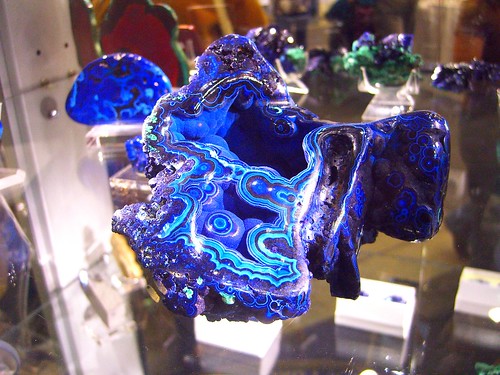
it's copper


it's copper, originally uploaded by livingplanet.

Well, the 2008 Tucson gem, mineral, and fossil show ended yesterday. It was a great showcase inspite of the traffic snafus, looming economic recession, rising prices, unpredictable weather (still the best in the nation), and other hassles.

We spent the last day visiting the premier show, the Tucson Gem and Mineral Society show at the Tucson Convention Center. This year's theme "Minerals of the USA" did not fail to impress. Display cases had collections from the Smithsonian, Carnegie, Royal Ontario Museum (Canada), and a number of private collections. I've uploaded a handful of pictures in Flickr and will continue to do so in the future (click on the link).


Enjoy!

Friday, February 15, 2008

Final weekend of 2008 Tucson Gem, Mineral, and Fossil Show

Beautiful Arizona petrified wood that seems to have grown out of the ground
Petrified Forest National Park, Arizona
Spring 2007, Copyright reserved, LivingPlanet


As the 2008 Tucson Gem, Mineral, and Fossil Show heads to its final weekend tomorrow, there are dark clouds forming. The first is the Tucson Weekly article by Tim Vanderpool on the hesitance of the U.S. federal government to take up sale offers by landowners of lands of achaeological, geological, and environmental significance. Of urgency are lands near or adjacent to the Petrified Forest National Park, Arizona.

I heard over the radio that the 2009 Tucson Show might see some 10 shows canceled because of the looming economic difficulties.

Don't forget to catch two related awesome events this weekend:

The mineral event of the year, the Tucson Gem and Mineral Society's 2008 "Minerals of the USA" show.

The Arizona State Museum's exhibit on the entitled: Set in Stone: 2000 Years of Gem and Mineral Trade in the Southwest


Finger Rock Trail, Tucson, Arizona

December 2007, better than a movie scene...


Global Map of human impact on world's marine ecosystem

figure from: http://www.nsf.gov/news/news_summ.jsp?cntn_id=111113

Scientists from a consortium of unviersities, NGOs, and U.S. government agencies published a report with several maps on the impact of human activities on the marine ecosystems. The findings are dire and urgent action is needed. Published in Science magazine, the study was funded by the U.S. National Science Foundation (NSF). At least 40% of the world's oceans are severely impacted and degraded by such varied activities/phenomena as fishing, pollution, trash, and global warming. See NSF's statement.